The Frustration Every Skincare Lover Knows
If you have ever applied your morning skincare only to watch tiny flakes roll off your face, you know how confusing and annoying pilling can be. It feels like the products you invested in are slipping away before they have even had a chance to help your skin. Many people assume pilling means their skin is rejecting a product or that nothing is being absorbed.
That idea is common but not supported by research. A large clinical study involving 528 women in Guangzhou examined pilling scientifically for the first time (LUA et al., 2024). The researchers found that 41 percent of participants experienced pilling during the testing process. The study also showed that pilling is not a sign of poor product quality or poor skin health. It is simply a physical reaction between your skin surface, your products and the way you apply them.
My aim here is to help you understand why this happens and how you can prevent it. When you understand the science, you can make decisions confidently instead of guessing.

The study showed that pilling is not a sign of poor product quality or poor skin health.
It is simply a physical reaction between your skin surface, your products and the way you apply them.
- The Frustration Every Skincare Lover Knows
- What Is Pilling?
- Why Does Pilling Happen? Four Factors Supported by Research
- What Is Happening on the Skin Surface? A Simple Explanation
- Choosing Formulations That Reduce Pilling Risk
- What To Avoid When You Want a Pill Free Routine
- Evidence Based Tips To Prevent Pilling
- When To Reassess Your Routine
- Pilling Is Preventable With the Right Knowledge
What Is Pilling?
Pilling is the formation of small, visible balls or flakes of product on the skin. It usually appears when you rub your skin during or after applying skincare or makeup. In the study by LUA et al., pilling occurred when a partially dried product film broke apart and rolled together on the skin surface.
Pilling does not mean a product failed to penetrate. It also does not mean your skin is not “accepting” a product. Many skincare and makeup formulas naturally create a soft film on the skin as water evaporates. These films help with even coverage, pigment stability and, in the case of sunscreens, UV protection. Under certain conditions, these films can break apart when rubbed.
Pilling is a mechanical event. It is related to skin conditions and friction, not product absorption.
Why Does Pilling Happen? Four Factors Supported by Research
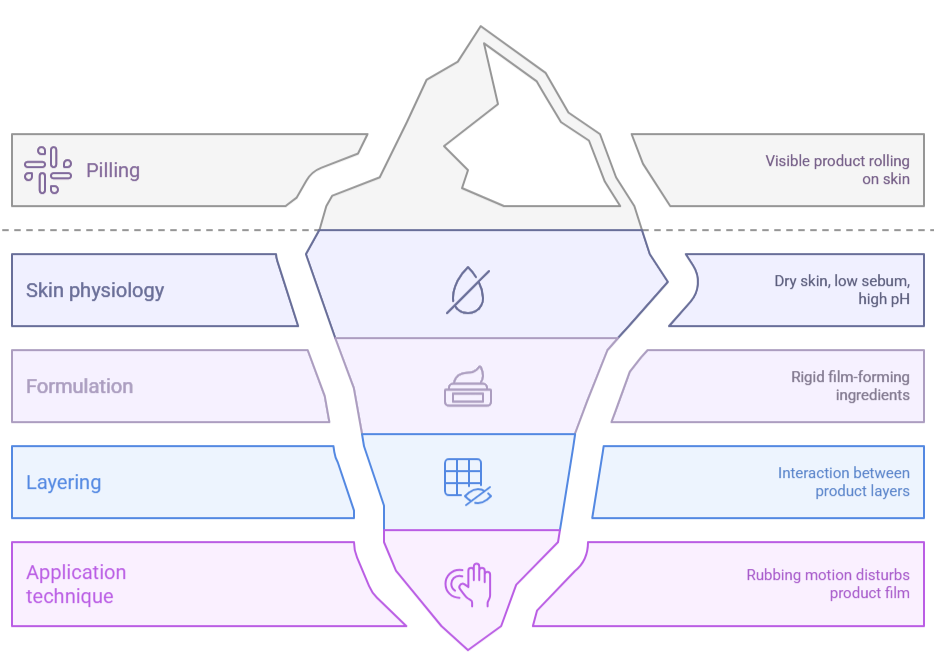
The study identified four main contributors to pilling: your skin physiology, the formulation you use, how you layer products and how you apply them.
1. Skin physiology
The researchers measured hydration, sebum, pH, skin texture, water loss and desquamation before product application. Women who experienced pilling tended to have drier skin, lower sebum, slightly higher pH and smoother skin texture. This pattern appeared both when sunscreen was used alone and when foundation was layered over a base product.
People with low hydration and low sebum generally have more friction on their skin surface. Without moisture or natural oils to provide slip, product films stiffen as they dry. Smoother skin also gives products fewer tiny grooves to settle into. These conditions make it easier for a film to roll when rubbed. A slightly higher pH can also affect how the outer skin cells interact with product films.
2. The formulation
Certain ingredients increase film strength, which is useful for long wear and protection. At the same time, these ingredients can make pilling more likely, especially when mixed with other products.
Examples include inorganic sunscreen filters such as zinc oxide or titanium dioxide, pigment-rich foundations, acrylic or vinyl polymer film-formers and silicone elastomers. These ingredients are not harmful, but when the film becomes too rigid or too thick, it can break apart when rubbed.
3. Layering
Layering is one of the strongest drivers of pilling. In the study, 80 percent of all pilling occurred when sunscreen was applied over another product. Only a very small number of pilling events happened when a base product was used alone.
This shows that the interaction between layers can create conditions that lead to film breakage. Differences in texture, drying speed or solids content can cause one layer to disturb another.
4. Application technique
The researchers observed how volunteers naturally applied products. Four methods were common: patting, pressing, circular rubbing and linear rubbing. Linear rubbing produced the most pilling, followed by circular rubbing. Patting and pressing produced far fewer events.
Friction is the key element. When the product film is disturbed before it fully settles, it becomes more likely to roll.
Pro tip
Use patting or pressing motions when applying sunscreens or makeup layers, especially if you know your skin tends to feel dry.
What Is Happening on the Skin Surface? A Simple Explanation
Understanding the sequence of events helps you anticipate and prevent pilling.
As a skincare product dries, water or other volatile ingredients evaporate. This leaves behind a thin film made of emollients, polymers, pigments or UV filters. When the skin is well hydrated and has a light layer of natural oil, this film remains flexible. But on dry or low-sebum skin, the film stiffens quickly.
If a second product is applied before the first has settled, or if the application involves rubbing, the film can tear. These torn fragments gather into small balls. This is the pilling you see.
How Skin Physiology Affects Pilling
| Skin Feature | What Happens to the Film | Pilling Likelihood |
| Low hydration (dry skin) | Film becomes stiff | Higher |
| Low sebum | More friction on skin | Higher |
| Higher pH | Changes surface cohesion | Higher |
| Smooth texture | Fewer grooves for product to settle | Higher |
Key takeaway
Pilling happens when the product film becomes unstable during application. Hydration, sebum, pH and friction all influence this process.
Choosing Formulations That Reduce Pilling Risk
The way a formula behaves on the skin influences how easily it pills. Emulsifiers, film formers, powders and UV filters each contribute to surface texture and stability. These features explain why some products create smoother layers while others are more prone to rolling.
Gel creams and lightweight emulsions often leave behind soft, flexible films that move easily with the skin. Hydrating serums with humectants help maintain moisture in the upper skin layers, which supports flexibility as products dry. Sunscreens or foundations with balanced silicone content can also glide more easily when layered.
In contrast, formulas with heavy pigment loads, high levels of inorganic sunscreen filters or large amounts of fast setting polymers tend to produce firmer films. These films can roll when rubbed, especially on dry or low sebum skin.
How Formulation Types Influence Pilling
| Formulation Type | Effect on Surface | Pilling Risk |
| Gel creams | More flexible film | Lower |
| Humectant serums | Improved surface hydration | Lower |
| High pigment formulas (some foundations) | Firmer film | Higher |
| Inorganic filter sunscreens | Dense solids on surface | Higher |
| Fast setting polymer formulas | Quick stiffening | Higher |
Pro tip
If a sunscreen pills repeatedly, try testing a different texture such as fluid, gel cream or a formula with fewer inorganic filters.
What To Avoid When You Want a Pill Free Routine
It is common for pilling to occur not because a product is poorly formulated, but because several incompatible layers are used together.
Mixing multiple thick or powder heavy layers often creates competing films that sit on top of each other rather than blending smoothly. When friction is added, they roll. The study reinforces this point by showing that sunscreen applied over another layer produced most of the pilling events recorded.
Rubbing is another major factor. The study found that linear rubbing produced the highest number of pilling events, followed by circular rubbing. Patting or pressing produced much lower rates.
Touching the same area repeatedly before a film settles also increases the chance of disruption. This is especially important with sunscreen, which produced the highest number of pilling events overall.
Evidence Based Tips To Prevent Pilling
The study and cosmetic dermatology references offer several ways to reduce pilling without sacrificing product performance.
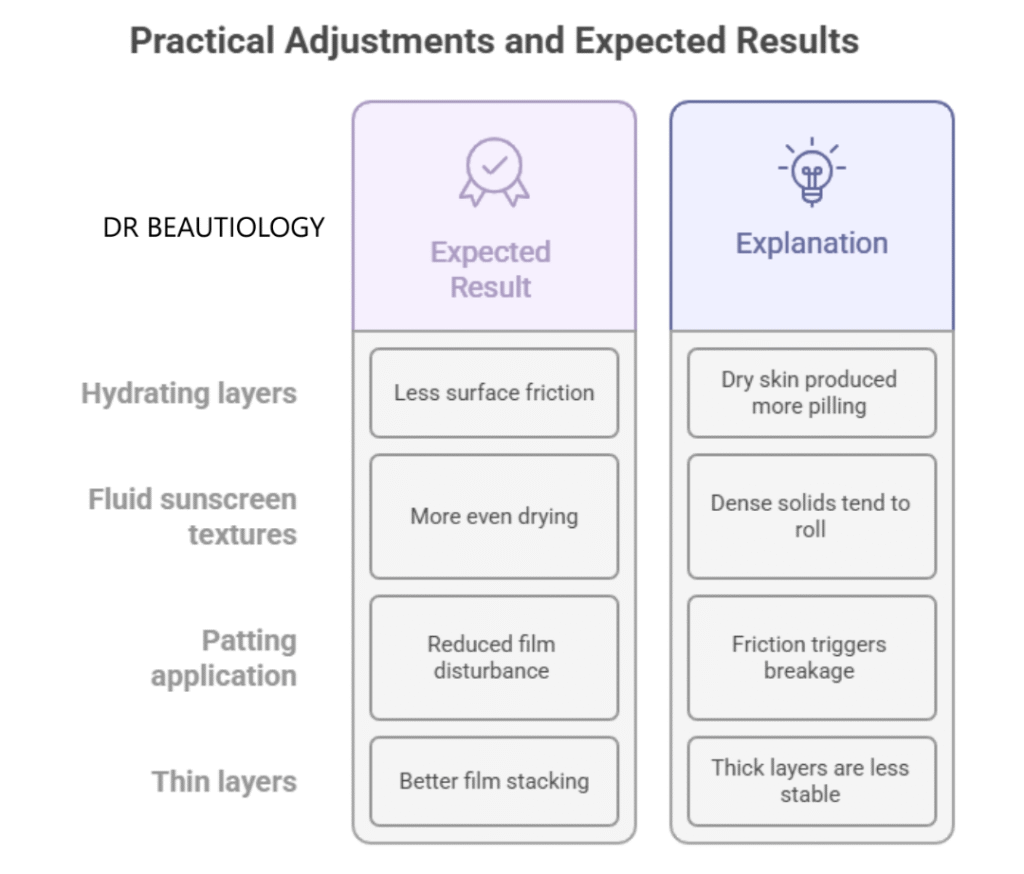
Hydrating the skin first can reduce friction and improve the flexibility of any film that forms on top. This was relevant in the study, where women with drier skin experienced more pilling events.
Allowing each layer to settle helps prevent one product from disturbing another. This is especially helpful when formulas contain solids or fast setting polymers.
Using low friction techniques such as patting or pressing lowers the chance of film breakage. Tools like soft sponges can also help because they reduce drag on the surface.
Choosing sunscreens with flexible or fluid textures can reduce the rolling that occurs with dense solids. Organic filter sunscreens or hybrid formulas may create smoother films depending on the specific product.
Practical Adjustments and Expected Results
| Adjustment | Expected Result | Explanation |
| Hydrating layers | Less surface friction | Dry skin produced more pilling in the study |
| Fluid sunscreen textures | More even drying | Dense solids tend to roll |
| Patting application | Reduced film disturbance | Friction triggers breakage |
| Thin layers | Better film stacking | Thick layers are less stable |
When To Reassess Your Routine
Pilling can be an indication that your routine is not suited to your skin’s hydration level, oiliness or texture. If pilling occurs only with sunscreen, it may be the sunscreen texture rather than your skin. If it occurs with almost every product, your cleansing or hydration approach may need revision. If it appears mainly when you rush, the issue is likely friction.
Understanding which pattern applies to you helps you make precise changes rather than replacing many products at once.
Pilling Is Preventable With the Right Knowledge
Pilling is a predictable surface reaction influenced by hydration, skin texture, product chemistry and application technique. Once you understand these factors, you can make decisions that support smoother, more reliable product layering.
If you’re ready to build a routine that works with your skin, not against it, subscribe for ongoing guidance shaped by evidence, not trends.
Talk to you soon!
Dr Bozica