Do You Really Need All Those Skincare Steps?
Choosing a simple vs advanced skincare routine is something many of us debate. Picture a group of friends comparing what they use: one sticks to a cleanser and moisturiser, another follows a multi-step ritual, and someone else glows using whatever was on sale. It raises a familiar question—does using more products actually improve the skin, or are we just complicating things? As someone who analyses skin science daily, I want you to have clarity grounded in evidence.
As someone who spends a lot of time analysing skin science, I want you to have answers you can trust. There is a published clinical study that compares a simple routine to an advanced one, using objective instruments rather than personal opinions.
- Do You Really Need All Those Skincare Steps?
- How Skincare Evolved Into Multi-Step Routines
- What the Clinical Study Reveals About a Simple vs Advanced Skincare Routine
- How an Advanced (Multi-Step) Skincare Routine Influences the Skin
- What An Advanced Skincare Routine Really Is
- Formulation Requirements And Compatibility
- Advanced vs Simple Routine: Who Benefits Most?
- How To Build A Science Backed Routine That Fits Your Life
- What This Study Cannot Tell Us
- Common Questions About Simple vs Advanced Routines
- Bringing It All Together
How Skincare Evolved Into Multi-Step Routines
Skincare did not always involve several bottles and layers. Early cosmetic care was simple: a cleanser, a moisturiser, and eventually sunscreen. The shift toward multi-step routines happened as formulation science advanced.
Once formulators understood how ingredients travel through the skin’s outer layers, new categories emerged. Serums were created to carry concentrated ingredients. Eye creams were developed for the thinner under eye area. Night creams incorporated ingredients that support skin renewal. Each product became more specialised.
Consumer interest also played a role. As people learned more about pigmentation, pollution exposure, and photoaging, they looked for products that addressed these concerns. Brands responded by expanding their ranges.
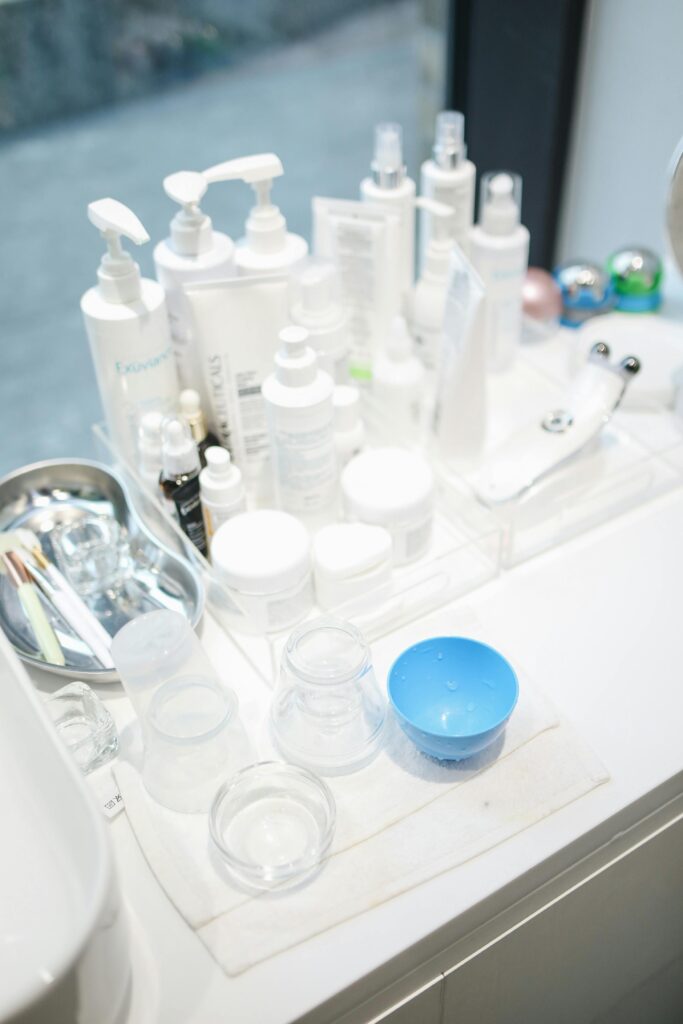
Pro tip: Before adding steps, think about your specific goals. A routine should support your skin, not overwhelm it.
What the Clinical Study Reveals About a Simple vs Advanced Skincare Routine
A study by Messaraa and colleagues in 2019 explored whether an advanced routine produces different results from a simple one. Forty-nine women aged 25 to 55 took part after a two-week washout with a basic moisturiser.
The routines looked like this:
| Routine | Products Used | When Used |
| Simple Routine | Cleanser + Day Cream (SPF 30) | Morning only |
| Cleanser + Toner + Eye Cream + Serum + Day Cream (AM) + Night Cream (PM) | Advanced Routine | Morning and evening |
The measurements collected before and after four weeks included skin hydration, wrinkle depth, brightness, roughness, pore area, and pigment and redness patterns. These measurements were made with instruments commonly used in cosmetic research, such as the Corneometer for hydration and the Antera 3D system for topography and chromophores.
The advanced routine products contained:
| Function | Ingredient | Notes |
|---|---|---|
| Antiaging botanical blend | Jania rubens extract, Sodium carrageenan | Day cream, night cream, serum, eye cream |
| Antioxidants | Açaí extract, Lactobacillus ferment | In most advanced products |
| Barrier and renewal support | Niacinamide, Glycolic acid | In the night cream |
| Humectants | Glycerin, Butylene glycol, Betaine, Sodium hyaluronate | Present across several advanced products |
| Pollution defence | Biosaccharide Gum-4 | Day cream |
| UV filters | Organic and inorganic filters | In both routines’ day creams |
Key findings:
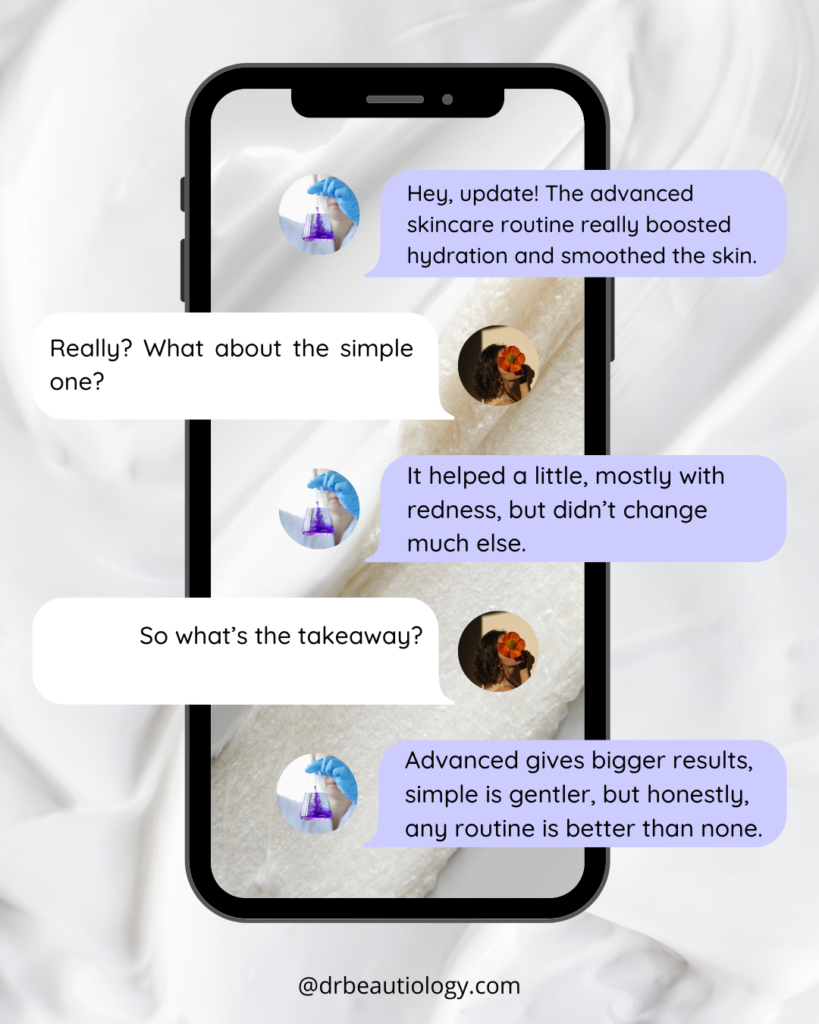
- The advanced routine increased superficial hydration by 92 percent and deep hydration by 25 percent. The simple routine increased superficial hydration by 16 percent and did not change deep hydration.
- The advanced routine reduced skin roughness and mean pore area, while the simple routine produced minimal changes.
- Both routines reduced nasolabial fold depth, but only the advanced routine reduced crow’s feet.
- Skin brightness and melanin unevenness improved more with the advanced routine.
- The simple routine improved redness variation slightly more, which may reflect lower irritation potential.
Key takeaway: More layers mean more exposure to humectants, emollients, and active ingredients. This appears to explain the differences, rather than the number of steps alone.
How an Advanced (Multi-Step) Skincare Routine Influences the Skin
To understand why the advanced routine performed better in several categories, it helps to look at how the skin responds to hydration, exfoliation, and targeted active ingredients. These mechanisms can influence visible appearance within weeks.
Hydration and the Skin Barrier
In the study, superficial hydration improved in both groups, but only the advanced routine improved deeper hydration. This fits what we know about humectants. Ingredients such as glycerin, betaine, and hyaluronic acid help the outer layer of the skin hold more water. Emollients fill spaces between cells, creating a smoother surface, and occlusive agents help reduce water loss.
Better hydration affects how light reflects off the skin, how evenly the skin sheds old cells, and how visible fine lines appear. These effects can occur fairly quickly because they are linked to the outermost layers of the skin ( check out here if drinking more water increases skin hydration).
Pro tip: If you want your skin to look smoother or more radiant without strong actives, increasing hydration is often the most direct path.
Surface Renewal with Glycolic Acid
The night cream in the advanced routine included glycolic acid, an alpha hydroxy acid often used at low concentrations to support gentle exfoliation. Glycolic acid helps older skin cells shed more evenly. This can improve skin brightness and make uneven pigmentation appear softer.
This mechanism helps explain the study findings of improved brightness, reduced surface roughness, and better melanin distribution.
Niacinamide and Barrier Support
Niacinamide has been widely studied for its ability to support the skin barrier and improve uneven tone. When paired with humectants and mild exfoliants in a night cream, it aligns with the improvements seen in the advanced routine. Niacinamide is a versatile ingredient that improves hydration, supports barrier function, and can help reduce the appearance of blotchiness.
Eye Cream for Around the Eye Area
The skin around the eyes is thinner and tends to lose moisture faster. Traditional day creams with SPF are often not applied close enough to the eyes to offer full protection. Using an eye cream with dedicated humectants and emollients twice daily provides extra support to this area.
This aligns with the study’s outcome: only the advanced routine produced a measurable change in crow’s feet depth.
Key takeaway: Each product in a multi-step routine influences a different aspect of the skin. When combined thoughtfully, the effects can add up within a few weeks.
What An Advanced Skincare Routine Really Is
By this point you might be thinking, “So what actually makes a routine advanced? Is it the number of bottles or what is inside them?” The Messaraa study is helpful here because the products used map very neatly to how cosmetic science frames a routine.
Rather than thinking in terms of ten steps, it is more useful to think in terms of functions. Each product is designed to do a particular job on or within the outer layers of the skin.
Functional Roles Of Each Step
In the advanced routine from the study, the steps and their likely functions look like this:
| Step | Main Job | Key Features In The Study Products |
| Cleanser | Remove surface oil, sweat, pollution and product residue | Daily facial cleanser, used in both routines |
| Toner | Add a first layer of hydration and soothing ingredients | Humectants such as glycerin, plus bisabolol for comfort |
| Eye cream | Support thin periocular skin and crow’s feet | Sodium hyaluronate, emollients, antiageing blend |
| Serum | Deliver concentrated actives for pores and early ageing | Saccharide isomerate for pores, botanical and antioxidant blend |
| Day cream with SPF | Hydrate, protect from UV and pollution particles | Humectants, emollients, organic and inorganic UV filters, Biosaccharide Gum-4 |
| Night cream | Support overnight renewal and barrier repair | Glycolic acid, niacinamide, humectants and emollients |
Why Formulation Type Matters
Serums are usually lighter, often water rich formulations that carry actives such as botanical extracts or saccharide derivatives closer to the upper layers of the epidermis. Moisturisers and night creams are typically emulsions with a higher lipid content, which improves comfort and reduces water loss. Eye creams often have a texture that sits comfortably around the eyes without migrating.
Vehicle is as important as the active. A poorly chosen base can limit penetration or increase irritation. For example, glycolic acid requires an appropriate pH and solvent system to be effective yet tolerable. Niacinamide performs best within certain pH ranges and in stable emulsions.
Key takeaway: An advanced routine is not just many products. It is a collection of formulations that each do a specific, complementary job.
Formulation Requirements And Compatibility
When you layer several products, the chemistry has to support that.
From the study products and dermatology texts, some broad principles emerge:
- Hydrating products need compatible humectants and film formers that hold water in the outer skin layers without feeling heavy.
- Exfoliating ingredients such as glycolic acid must be used at appropriate concentrations and pH in a well designed vehicle to avoid unnecessary irritation.
- Barrier supporting ingredients such as niacinamide should sit in emulsions that do not strip the skin.
- Eye formulations should be low in irritants, with textures that stay put.
Potential Incompatibilities
There are also reasonable concerns when multiple products are used together.
- Using several leave on products increases exposure to preservatives, fragrances and surface active agents, each of which can contribute to irritant or allergic contact dermatitis in susceptible people.
- Combining more than one exfoliating product can increase stinging, redness or barrier disruption, especially on sensitive or already inflamed skin.
- Over cleansing or using harsher surfactant systems more often than necessary can deplete lipids in the stratum corneum and increase water loss.
The Messaraa study did not report major safety problems over four weeks, but the authors themselves suggest that very complex routines, such as those popular in some K beauty circles, should be assessed carefully for microbiome and barrier effects.

Pro tip: If your skin is often itchy, red or easily irritated, prioritise a well formulated moisturiser and gentle cleanser first. Extra steps can be added slowly once your barrier is comfortable.
Advanced vs Simple Routine: Who Benefits Most?
The most helpful way to use this research is not to declare a winner, but to match the routine style to the person in front of the mirror.
When a Simple Skincare Routine Is the Better Choice
In the study, the simple routine still improved superficial hydration and reduced nasolabial fold depth. It also produced a slightly larger improvement in haemoglobin heterogeneity, which reflects redness patterns, compared with the advanced routine.
This fits neatly with what cosmetic dermatology texts recommend for sensitive or redness prone skin. For people with conditions such as rosacea or eczema, guidelines often focus on fewer, well tolerated products, with strict attention to fragrance, surfactant type and preservative systems.
A simple routine is particularly suited to:
- Skin that flushes or stings easily.
- People with a history of contact dermatitis.
- Those who are new to skincare or have struggled with irritation from active rich products.
- Times of barrier stress, such as after a procedure or during a flare of a skin condition.
Key takeaway: A short, consistent routine can still deliver measurable benefits, especially for hydration and lines that are strongly influenced by surface water content.
When An Advanced Routine Can Offer Extra Gains
In contrast, the advanced routine in the Messaraa study produced greater changes in several visually important parameters: deep hydration, surface roughness, mean pore area, crow’s feet depth, overall brightness and melanin unevenness.
These are concerns that often trouble people in their thirties, forties and beyond, or those with early photoaging.
Dermatology references on antiageing regimens frequently describe a multi step approach that includes:
- A gentle but effective cleanser.
- A daily sunscreen.
- A hydrating moisturiser.
- A topical active that promotes renewal or supports collagen, such as a hydroxy acid or retinoid.
- Optional additions for pigmentation, such as niacinamide or other pigment modulating agents.
The advanced routine from the study reflects this style, combining hydration, mild exfoliation, barrier support, antioxidants and UV protection.
It is best suited to:
- Early fine lines, particularly around the eyes.
- Uneven texture or enlarged pores.
- Dullness and mild uneven pigmentation.
- People who enjoy skincare as a daily ritual and can realistically follow morning and evening steps.
Pro tip: If your main concerns are texture, early lines and uneven tone, you are more likely to see extra benefit from additional steps than someone whose only concern is dryness.
How To Build A Science Backed Routine That Fits Your Life
A helpful way to apply all this is to think in layers of importance. Start with what every skin needs, then decide where additional steps genuinely earn their place.
Step 1: Lock In The Essentials
Every dermatology text that covers cosmetic care comes back to three pillars:
- Cleansing.
- Moisturising.
- Sun protection.
The brands and textures may differ, but these functions appear again and again in recommended regimens.
For most people, a gentle cleanser, a moisturiser suited to their skin type, and a reliable broad spectrum SPF are the non negotiable starting point. The Messaraa study confirms that even this simple level of care improves hydration and certain lines.
Key takeaway: If these three are not in place, extra serums and treatments will never live up to their potential.
Step 2: Add One Targeted Step At A Time
If you decide to build out an advanced routine, add selectively.
You might introduce:
- An eye cream if you are noticing fine lines or dryness around the eyes.
- A serum focused on your primary concern, such as uneven tone or visible pores.
- A night cream with ingredients like glycolic acid and niacinamide if your barrier is stable and you wish to address texture and early pigmentation.
The key is to adjust one variable at a time. This mirrors clinical practice, where dermatologists often recommend introducing actives slowly so the skin’s response can be observed.
Pro tip: Keep a simple note in your phone of when you start a new product and any changes you notice. This helps you link cause and effect more clearly.
Step 3: Match Routine Complexity To Your Reality
There is no advantage in a seven step routine that you cannot maintain. The best regimen is one that you can perform most days without stress.
If mornings are rushed, you might reserve most active steps for evening and prioritise cleanse, treat, protect at night, then cleanse and protect in the morning. If you enjoy the ritual, you may find a fuller routine helps you stay consistent.

Pleasant texture and feasible routines often improve long term results more than aggressive products that are abandoned after a few weeks.
What This Study Cannot Tell Us
Being honest about limitations is central to good science. The Messaraa study offers useful insights, but it does not answer every question.
Short Duration
The study ran for four weeks. This is long enough to see changes in hydration, surface texture and some aspects of brightness, since these are linked to the stratum corneum. It is not long enough to fully assess deeper structural changes in collagen or long term pigmentation control, which usually require several months of observation.
Product And Dose Confounding
The advanced routine was not just more steps, it was also used twice daily and contained more active ingredients, including glycolic acid and niacinamide that did not appear in the simple routine. This means we cannot say whether it was the extra steps, the extra dose of ingredients, or the specific actives that drove the differences.
From a practical point of view this may not concern you, but from a scientific perspective it makes it harder to isolate which components are essential.
Sponsor And Sample
The study was funded by the company that supplied the products, which is common in cosmetic research. It followed ethical guidelines and used validated instruments, but independent replication would always strengthen confidence.
The volunteers were healthy adult women within a fairly narrow age range. The findings may not fully apply to men, to much older or younger people, or to those with active inflammatory skin conditions.
Key takeaway: The study shows that this particular advanced routine outperformed this particular simple routine over four weeks. It does not prove that every advanced routine is better than every simple routine.
Common Questions About Simple vs Advanced Routines
“Do I need a multi step routine for antiageing?”
Not everyone does. A simple routine that includes a gentle cleanser, a moisturiser and daily broad spectrum sun protection aligns with standard dermatology advice for preventing and slowing visible photoageing. However, if you already have fine lines, uneven tone or texture, adding one or two well chosen active products, such as a hydroxy acid or a niacinamide containing night cream, can provide extra benefit, as suggested by both the Messaraa data and textbook regimens.
“Is a long routine always better?”
No. The advanced routine in the study performed better because it provided more hydration, mild exfoliation and dedicated products for different areas, not simply because it had more steps. A poorly designed long routine that irritates your skin or is used inconsistently is unlikely to outperform a simple, good quality one.
“Can I mix products from different brands?”
From a skin biology perspective, the brand is less important than the ingredients, the vehicle and how your skin responds. Dermatology references focus on ingredient classes and formulation types rather than specific labels. The main risks of mixing are over exposure to strong actives or irritating combinations. Introduce changes gradually so you can detect any problems.
“Is an advanced routine safe for sensitive skin?”
Sometimes, but not always. The study did not focus on people with diagnosed sensitive skin conditions. Texts on rosacea, eczema and contact dermatitis tend to recommend simpler, fragrance free, low surfactant routines as a baseline. If you have sensitive skin and wish to add actives, it is wise to consult a dermatologist and introduce one product at a time.
“How long until I see changes?”
In the Messaraa study, differences were measured after four weeks. This is consistent with typical epidermal turnover times, which are often around four weeks in adults. Hydration and surface smoothness can sometimes improve within days, while pigmentation and deeper wrinkles usually take longer.
Bringing It All Together
If you strip away the marketing language that often surrounds skincare, what remains is quite simple. Skin responds to regular cleansing, consistent hydration, thoughtful protection and, when appropriate, carefully chosen active ingredients.
The Messaraa study shows that an advanced routine, used twice daily and built around humectants, emollients, a gentle exfoliant, niacinamide, antioxidants and daily SPF, can create more change in several visible features over four weeks than a basic cleanser plus day cream. At the same time, it also shows that a simple routine still improves hydration and some lines, and may be kinder for redness prone skin.
You do not have to choose between “minimalist” and “maximalist” as identities. You can start with a strong simple base, add steps when there is clear scientific justification, and adjust as your skin and life shift.
My aim is not to sell you a number of steps, but to help you become literate in your own skin. When you understand why a product earns its place, you can build a routine that feels both effective and sustainable.
If you liked this article, please subscribe to the newsletter. I publish new articles every week.
Talk to you soon!
Dr Bozica