Green tea can affect some of the reactions involved in UV-related skin ageing, but a cup of tea, a concentrated supplement and a facial cream do not expose your skin to green tea in the same way.
Green tea has an appealing skincare story. It contains catechins, including EGCG, and repeated ultraviolet exposure contributes to wrinkles by damaging the structures that keep skin firm. In laboratory studies, green tea catechins can interfere with some of the oxidative and inflammatory reactions triggered by UV.
Does that mean drinking green tea or applying it to your face will prevent wrinkles?
No human trial has shown that green tea stops new wrinkles from forming. Two small studies reported improvements in wrinkles that were already present after people used specially prepared topical formulas. Studies of green tea drinks and supplements measured different outcomes, including skin redness after controlled UV exposure, biopsy findings and existing photoageing. Their results have varied.
A short-term change in UV redness cannot tell us whether someone will develop fewer wrinkles over the next decade. To understand what green tea may do for skin, we need to look at what was tested and what the researchers actually measured.
How could green tea affect wrinkle formation?
Wrinkles do not appear because skin simply “runs out” of antioxidants. Repeated UV exposure activates chemical reactions and inflammatory signals in the skin. These can increase enzymes that break down collagen and can interfere with the fibroblasts responsible for maintaining the dermis. Collagen gradually becomes more fragmented and disorganised, while elastic fibres also change.
Green tea catechins have affected several parts of this process in cell and animal studies. Human skin creates a harder delivery problem. A catechin that changes an isolated cell in a laboratory still needs to remain intact in a product and reach living skin in a high enough concentration before we can expect a similar effect on the face. Roh et al., 2017
Oral green tea faces a different route. Catechins pass through digestion and metabolism before catechins or their metabolites reach the skin. This is why results from a capsule cannot be used to prove that a serum works, and a topical study cannot tell us what ordinary brewed tea will do.
What did the human studies test?
| Study | What was tested | What happened | What remains unanswered |
|---|---|---|---|
| Hong et al., 2013 | Normal green tea extract or tannase-treated green tea extract applied to crow’s feet for eight weeks | The tannase-treated extract produced larger reductions in skin-replica roughness measurements | Both groups received green tea. The study did not include the same cream without green tea |
| Wisuitiprot et al., 2022 | Green-tea-loaded chitosan microparticles on one side of the face and the cream base on the other for eight weeks | Elasticity was slightly higher on the green tea side at week four, while photographs favoured that side for wrinkles at week eight | Only 29 women took part, and wrinkle depth was not measured with an instrument |
| Chiu et al., 2005 | A 10% green tea cream used together with oral green tea capsules for eight weeks | Biopsies contained more elastic tissue, but clinical assessment found no visible improvement in photoageing | The oral and topical treatments were combined, so their individual effects cannot be separated |
| Heinrich et al., 2011 | One litre of a prepared drink supplying 1,402 mg of catechins daily for 12 weeks | UV-induced redness decreased, and several instrument-based skin measurements improved | The drink was far more controlled and concentrated than ordinary brewed tea, and wrinkles were not measured |
| Farrar et al., 2015, Farrar et al., 2018 and Charoenchon et al., 2022 | 1,080 mg of green tea catechins with vitamin C daily for 12 weeks | The supplement did not reduce UV redness, inflammatory-cell movement into skin or direct UV-induced DNA damage. A later biopsy analysis found a change involving one elastic-fibre-associated protein, but not the wider collagen or elastic-fibre networks | The experiment used one acute, high UV dose. It did not examine wrinkle formation during everyday sun exposure |
| Janjua et al., 2009 | 250 mg of oral green tea polyphenols twice daily for two years | Some measures changed at earlier visits, but after 24 months the supplement was no better than placebo for clinical or biopsy measures of photoageing | Participants already had photoaged skin, so the trial assessed existing damage rather than prevention in unaffected skin |
Can topical green tea improve existing wrinkles?
The topical studies looked at wrinkles directly, but each one tested a particular extract and delivery system.
In the 2013 crow’s-feet study, researchers treated green tea extract with an enzyme called tannase. This changed the catechin mixture. After eight weeks, the treated extract reduced skin-replica roughness more than the normal extract.
The percentages commonly repeated from this paper need careful reading. The figures of 63.6% and 36.3% were the proportions of participants who reported moderate or marked improvement. They were not percentage reductions in wrinkle depth.
Tannase treatment improved the performance of the green tea formula. Because no group used the same cream without green tea, we still do not know whether either extract improved wrinkles beyond the effect of the cream itself.
The 2022 split-face trial included a cream-base comparison. Twenty-nine women applied green tea extract encapsulated in chitosan microparticles to one side of the face and the cream base to the other. Skin elasticity was slightly higher on the treated side at week four. At week eight, photographs appeared to show greater wrinkle improvement on that side. Neither cream caused visible irritation.
Researchers tested green tea inside chitosan microparticles. These particles can change how an extract is protected and presented to the skin. A toner or moisturiser containing Camellia sinensis leaf extract has not been tested simply because it shares the same plant name.
In the Chiu trial, participants used a 10% green tea cream while also taking green tea capsules. After eight weeks, biopsies showed an increase in elastic tissue content, yet clinicians could not see an improvement in photoageing.
Elastic tissue content in a biopsy is not the same measurement as skin elasticity, and neither one confirms wrinkle reduction. Because topical and oral green tea were used together, we also cannot identify which treatment produced the biopsy finding.
Topical green tea may improve existing wrinkles when the extract is processed and delivered in a suitable formula. The current studies cannot predict how an untested green tea serum will perform.
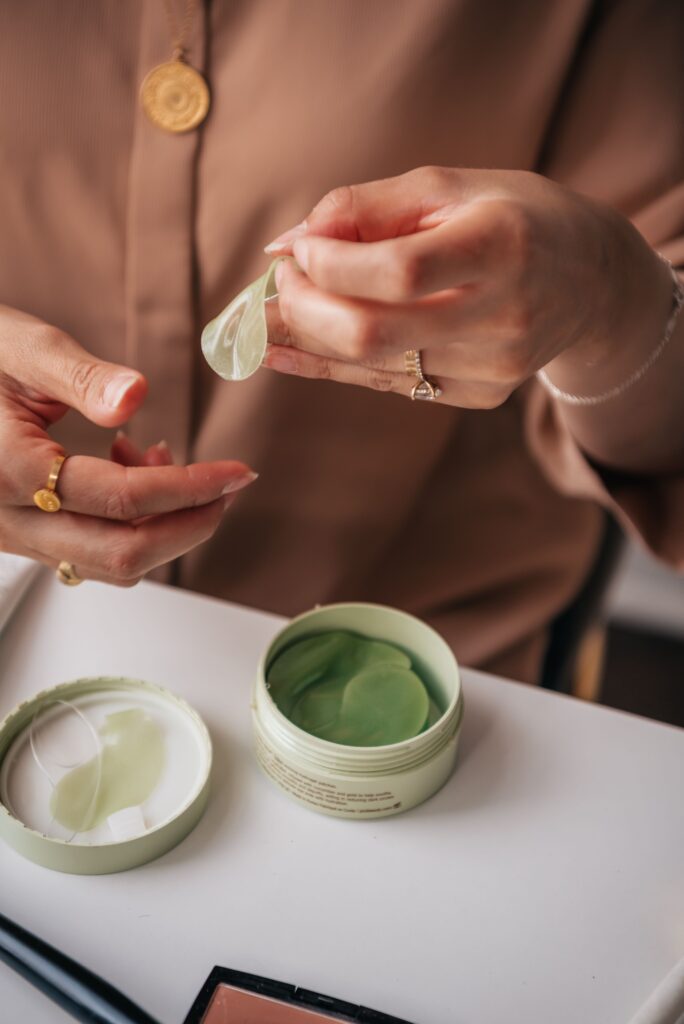
Green tea extract tells you what entered the bottle, not how much remained active or reached your skin
Does drinking green tea protect skin from UV damage?
One positive oral study is often described as a trial in which women drank a litre of green tea each day. That description makes the drink sound much closer to home-brewed tea than it was.
The test beverage supplied 1,402 mg of catechins per day, including about 980 mg of EGCG, and contained vitamin C to stabilise the catechins. Sixty women drank either the green tea beverage or a matched control for 12 weeks. UV-induced redness decreased by 16% after six weeks and by 25% after 12 weeks in the green tea group. Measurements of elasticity, density, roughness, scaling and skin water balance also changed. Heinrich et al., 2011
Ordinary tea varies with the leaves, dose, water temperature and brewing time. Drinking one litre of tea at home does not guarantee the catechin exposure used in this experiment. The study also measured the skin’s response to a controlled UV challenge rather than the development of wrinkles.
Another research group tested 1,080 mg of green tea catechins with 100 mg of vitamin C daily for 12 weeks. Compared with placebo, the supplement did not reduce UV-induced redness. It also did not reduce the inflammatory-cell response or the inflammatory compounds measured in the skin. A later analysis found no reduction in cyclobutane pyrimidine dimers, which are a form of DNA damage produced directly by UV. Farrar et al., 2015, Farrar et al., 2018
Biopsies from the same trial were later examined for changes in the dermal framework. The UV-related reduction in fibulin-5 seen in the placebo group was absent in the catechin group. Fibulin-5 is associated with elastic fibres. The researchers found no comparable protection across the collagen network or the overall elastic-fibre network, and fibulin-5 levels in UV-exposed skin did not differ significantly between the two groups. Charoenchon et al., 2022
The studies used different catechin preparations and different UV protocols. One beverage reduced redness under its test conditions. The other high-dose preparation did not. Neither trial followed wrinkle development.
What did the two-year supplement study find?
The longest study included 56 women with existing photoageing. They took 250 mg of green tea polyphenols or placebo twice a day for two years.
Within the green tea group, clinical scores for overall solar damage improved at six months, followed by redness and visible small blood vessels at 12 months. By 24 months, the supplement had not performed better than placebo on the clinical or biopsy measures of photoageing. Janjua et al., 2009
The earlier changes did not develop into a broader advantage after two years. The women already had photodamaged skin when the study began, so this trial examined existing damage rather than prevention.
Why does less UV redness not mean fewer wrinkles?
UV redness mainly reflects a short-term vascular and inflammatory response. If redness decreases after a controlled exposure, the skin reacted differently on that occasion. We still do not know whether collagen was preserved over time.
Redness and DNA damage are separate outcomes. A preparation could reduce redness without preventing direct UV damage to DNA. It could also change a protein in a biopsy without producing a visible difference in wrinkles.
A wrinkle-prevention trial would need to follow comparable groups for years. Researchers would have to measure new lines or changes in wrinkle depth while accounting for sun exposure, sunscreen use and other active skincare. Green tea has not been tested this way.
Why does the green tea formula affect the result?
Green tea extract is not a single, fixed ingredient. The plant material and extraction method determine which catechins enter the raw material. Later processing can change that mixture, as the tannase study demonstrated.
Catechins also need to survive manufacturing and storage. EGCG is prone to degradation in water, and its stability changes with pH and temperature. Oxygen and light can contribute to degradation under some formulation conditions. Li et al., 2012, Secretan et al., 2021
If you have seen a vitamin C serum turn brown as it oxidises, you already understand the practical problem. Calling an ingredient an antioxidant does not guarantee that it remains intact inside the bottle.
The formula then has to release the catechins and help them reach the skin. Concentration, vehicle and delivery system all influence that process. The positive split-face trial used chitosan microparticles, while the tannase study used a chemically altered extract. Neither result can be assigned to every product listing green tea.
A label that says “5% green tea extract” does not mean 5% EGCG. It also does not reveal how much EGCG remains during the product’s shelf life.
Pro tip: Look for a controlled human study of the finished product. If a brand cites a study of swallowed catechins beneath a serum, that study cannot show that the serum keeps its catechins stable or delivers them into skin. I explain the same formulation problem in Vitamin C for Skin: What Works and What Fails.
Is drinking green tea the same as taking green tea extract?
Brewed tea and concentrated extracts can provide very different doses of EGCG.
The European Food Safety Authority considered catechins from traditional green tea infusions generally safe, although rare liver reactions have been reported. In intervention studies of supplements, EGCG doses at or above 800 mg per day were associated with increased liver enzymes in some participants. EFSA could not identify a supplement dose that would present no risk for every person. EFSA, 2018
The 800 mg figure does not mark a universal toxicity threshold, and a dose below it cannot guarantee safety for everyone. Food intake and concentrated extracts produce different exposures.
The prepared beverage in the Heinrich skin study supplied about 980 mg of EGCG each day. Its liquid format differs from a concentrated capsule, so the supplement findings cannot be transferred directly to that drink. A 12-week skin study also cannot establish the long-term safety of recreating that dose yourself.
Enjoying ordinary green tea as a drink is a different decision from taking a high-dose extract for skin. The wrinkle research gives no reason to chase the experimental dose with supplements.
Should you use green tea for wrinkles?
| If you are considering… | What to know |
|---|---|
| Drinking ordinary green tea | The human skin studies used defined preparations, often with much higher catechin exposure than ordinary tea. Brewed green tea has not been shown to prevent wrinkles. |
| A green tea serum or moisturiser | Two specialised topical formulas improved some wrinkle-related measurements. The ingredient name alone cannot predict how another product will perform |
| A concentrated green tea supplement | Skin findings have varied, while high-dose EGCG extracts raise a liver-safety concern |
| Using green tea instead of sunscreen | Green tea has not been shown to replace sunscreen. One high-dose oral trial found no reduction in direct UV-induced DNA damage |
For preventing UV-related skin ageing, sunscreen acts on the main preventable cause before the UV reaches living skin. Green tea has not shown comparable protection. If you want to treat existing wrinkles, retinoids have been studied far more extensively in humans. I compare those options in Retinol vs Vitamin C for Skin Ageing.
Green tea may still make sense in a well-formulated product that suits your skin. At present, the human research does not show that drinking tea, taking green tea extract or choosing any cream with green tea on its ingredient list will prevent new wrinkles.
Talk to you soon!
Dr Bozica