

Why some vitamin C serums sting and how to choose one your skin can tolerate
Sensitive skin does not automatically rule out vitamin C. First, check whether your skin is irritated. If water, cleanser or your usual moisturiser stings today, leave the vitamin C serum for later.
Once your skin feels normal again, look at the form of vitamin C and the complete formula. L-ascorbic acid has the strongest human evidence, although the acidic formulas used to deliver it can sting. A derivative may be easier to tolerate because it can often be formulated at a higher pH, but the results are less predictable.
Use vitamin C for uneven pigmentation or early changes caused by sun exposure. It has not been shown to treat skin sensitivity itself.
- Start with what your skin is doing now
- Why L-ascorbic acid often stings
- Would a vitamin C derivative be easier to tolerate?
- What vitamin C can improve
- Why the finished serum can perform differently from the ingredient
- How to introduce vitamin C when your skin is sensitive
- Should you use vitamin C if you have sensitive skin?
- FAQ
- References
Start with what your skin is doing now
Sensitive skin tends to sting, burn, itch or tingle after triggers that other skin tolerates. It may become red, although it can also look normal while it feels uncomfortable (Misery et al., 2017).
Sometimes this reaction comes with a damaged skin barrier. The lipids between the outer skin cells help slow water loss and limit the entry of irritating substances. When those lipids become disrupted, more water escapes and ingredients enter more easily. Your skin may then feel dry or tight, and products that were previously comfortable can start to sting.
However, sensitive skin and a damaged barrier are not the same thing. Persistent flushing, visible blood vessels, scaling, swelling or an itchy rash may indicate rosacea, eczema or contact dermatitis. Changing from one vitamin C serum to another will not correct the underlying condition.
If ordinary skincare has suddenly started to burn, wait until the reaction has settled before testing another active. You can read more about the causes of sensitivity in The Science of Sensitive Skin and How Niacinamide Helps.
Why L-ascorbic acid often stings
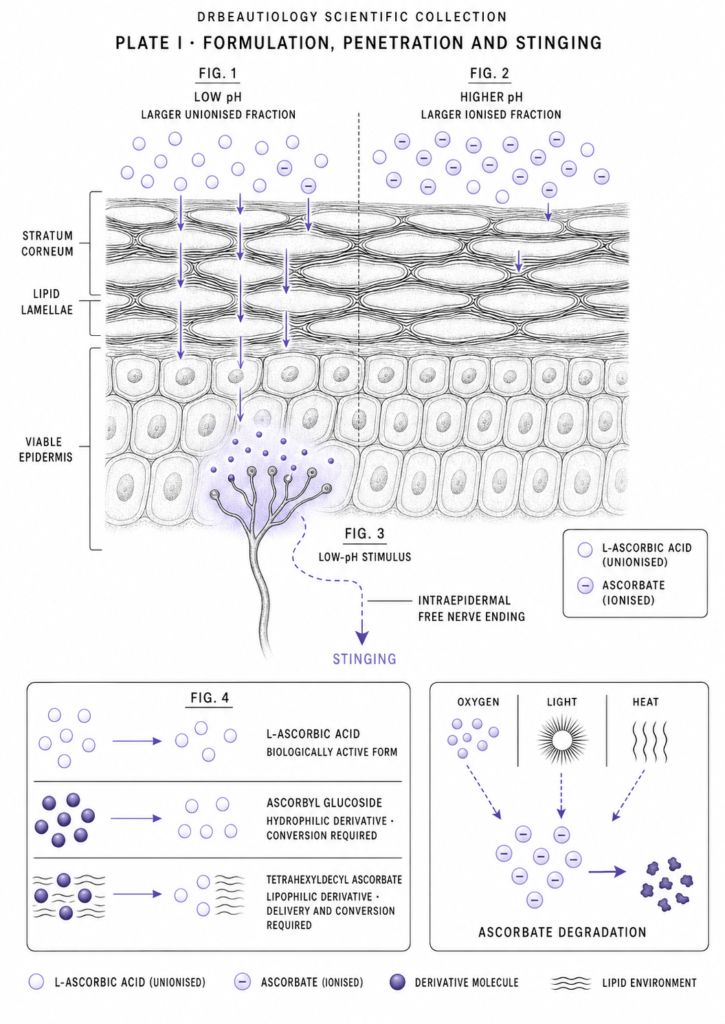
L-ascorbic acid dissolves readily in water. The outer skin barrier contains many lipids, so a water-soluble molecule does not move through it easily.
The pH of the serum changes how much L-ascorbic acid carries an electrical charge. At a higher pH, more of it is charged and has difficulty moving into the lipid-rich barrier. Lowering the pH leaves more of the molecule uncharged, which improves its movement from the serum into skin. In one absorption study, L-ascorbic acid penetrated only when the formula was below pH 3.5 (Pinnell et al., 2001).
The same low pH can stimulate sensory nerves and cause stinging. The reaction is more likely when exfoliation has thinned the outer layer or when dryness and inflammation have already made the skin more permeable.
This is why the percentage on the bottle cannot predict whether a serum will burn. A 10% L-ascorbic acid serum may still have a pH close to 3. Alcohol, fragrance or an exfoliating acid in the same formula can increase the irritation further.
If your skin usually tolerates acidic products, L-ascorbic acid gives you the strongest direct evidence. If low-pH products repeatedly sting, a derivative may be a better place to start.
Would a vitamin C derivative be easier to tolerate?
Vitamin C derivatives are modified forms of ascorbic acid. The modification changes how the ingredient dissolves, how it is formulated and how it enters skin.
Magnesium ascorbyl phosphate, sodium ascorbyl phosphate and ascorbyl glucoside dissolve in water. Tetrahexyldecyl ascorbate dissolves in oil. Their solubility affects the type of serum in which they can be used and how they are delivered into skin.
Many derivative serums can be made at a higher pH. Removing the very low pH may reduce acid-related stinging. The serum can still irritate your skin if it contains fragrance, a high amount of alcohol or another active that your skin does not tolerate.
Derivatives also have less direct human evidence. They must reach the skin and, depending on the form, convert into ascorbic acid before they can take part in the same reactions. We do not know equally well how effectively each derivative completes these steps.
Choose L-ascorbic acid when your skin is settled and acidic products feel comfortable. Choose a simple derivative serum when low-pH formulas repeatedly burn. Check the rest of the ingredient list in either product because your skin is exposed to the whole formula.
What vitamin C can improve
Once you have found a form your skin is likely to tolerate, decide why you want to use it.
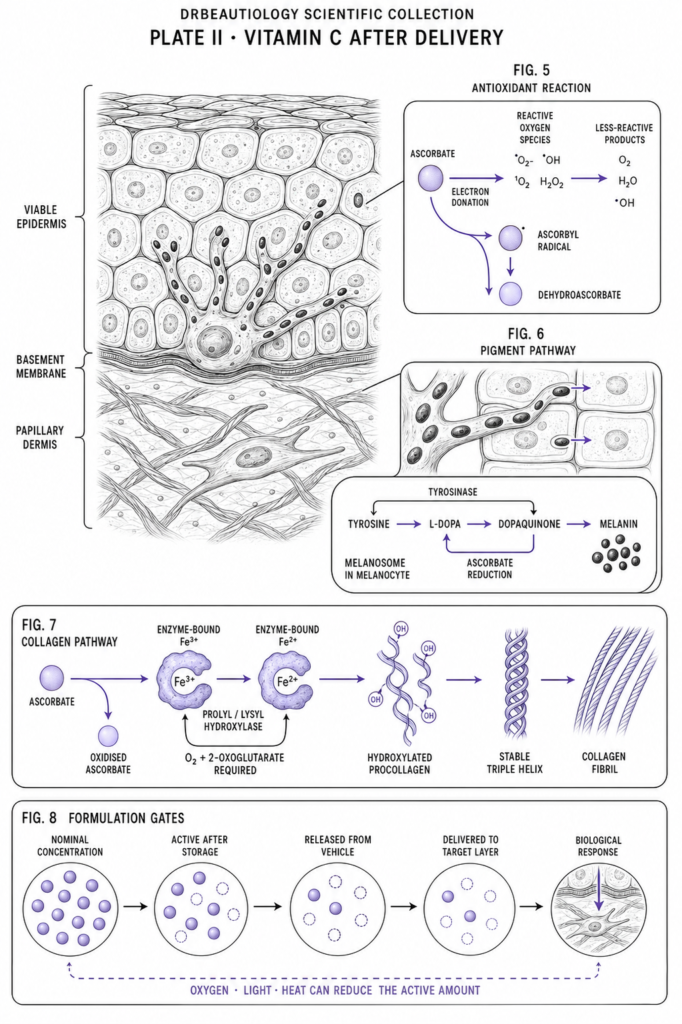
UV exposure generates reactive oxygen species in skin. These molecules can damage lipids, proteins and DNA. They also alter the signals that control collagen breakdown and melanin production. Repeated exposure can therefore contribute to uneven pigmentation, rougher texture and fine lines.
Vitamin C donates electrons to reactive oxygen species and interrupts some of these reactions. Sunscreen remains the main protection because it reduces the UV exposure that starts the process. Vitamin C can act on some oxidative reactions that still occur after exposure. I explain the difference in Do Antioxidant Serums Work for Oxidative Stress in Skin?.
Vitamin C also takes part in the enzyme reactions needed to form stable collagen. Human studies using specific topical formulas found modest improvements in fine lines and skin texture (Humbert et al., 2003; Fitzpatrick and Rostan, 2002). The result depends on the formula because the vitamin C must remain active and reach the skin before it can take part in those reactions.
Vitamin C can also slow reactions involved in melanin production, so it may gradually improve uneven pigmentation. In a small melasma study, 5% ascorbic acid improved pigmentation less than 4% hydroquinone and caused fewer adverse effects (Espinal-Perez et al., 2004). A cosmetic vitamin C serum may help dark marks fade, although that result does not make it an equal replacement for a stronger pigment treatment.
For a closer look at the evidence behind these effects, read Vitamin C for Skin: What Works and What Fails.
Vitamin C has not been shown to stop the burning, itching or flushing that defines sensitive skin. If those symptoms are your main concern, find the cause of the reaction first. Add vitamin C later if you also want to address pigmentation or early sun-related changes.
Why the finished serum can perform differently from the ingredient
When I test an antioxidant in an oxidative-stress assay, I can place the antioxidant and the stressor in the same well. Direct contact removes most of the delivery problems.
In a serum, the vitamin C must remain active during manufacture and storage. After application, it must leave the formula and cross the outer skin barrier. If little active vitamin C reaches the skin, strong antioxidant activity in an assay will not produce the same response on your face.
L-ascorbic acid can oxidise while the serum sits in the bottle. Oxygen, light and heat speed up this process, so less active vitamin C remains available for delivery.
Choose packaging that limits air and light exposure, and close the bottle promptly after use. If a serum that began clear or pale becomes dark orange or brown, oxidation may be occurring. The colour cannot measure exactly how much L-ascorbic acid remains because formulas begin with different colours. A marked change from the original colour is still a reason to question the product. I explain what the colour change means in Why Vitamin C Serum Turns Brown, and When to Stop Using It.
Do not compare serums by percentage alone. The percentage describes how much vitamin C was added during manufacture. Storage determines how much remains in the bottle, and skin delivery determines how much reaches the place where it can act.
How to introduce vitamin C when your skin is sensitive
Start when your existing routine feels comfortable. If your skin is already burning, you will not know whether the vitamin C caused the reaction or increased one that was already present.
Apply the serum to a small area of your face on several separate days. Irritation can appear after repeated use, so one application behind the ear is not enough to predict how your face will respond.
If the test area remains comfortable, use the serum across your face two or three times a week. Keep the rest of your routine unchanged while you assess it. Adding several unfamiliar products together makes the cause of a reaction difficult to identify.
Introduce retinoids and exfoliating acids separately. Once your skin tolerates each product on its own, use them at different times of day or on different days if the combination causes stinging. L-ascorbic acid needs particular care around glycolic acid because both formulas can irritate sensitive skin. Read What Not to Mix With Glycolic Acid before using them in the same routine.
Brief tingling can occur with an acidic serum because the low pH stimulates sensory nerves. That sensation provides no information about how much vitamin C entered your skin and cannot predict a better result.
Stop using the serum if burning persists or redness continues to worsen. Swelling, peeling or a rash also means that the formula is not suitable for your skin. If several unrelated products cause the same reaction, see a dermatologist before testing more products.
Should you use vitamin C if you have sensitive skin?
Yes, if your skin is currently settled and you want to address uneven pigmentation or early sun-related changes.
Choose L-ascorbic acid if you tolerate acidic products. Choose a simple derivative serum if low-pH products repeatedly sting. Whichever form you use, check the complete formula, introduce it slowly and stop if the reaction continues after application.
If cleanser or moisturiser already burns, wait. Vitamin C will not treat the sensitivity, and an acidic serum may make the reaction worse.
FAQ
Can vitamin C serum reduce redness?
Ordinary vitamin C serums have not been shown to treat routine flushing or sensitive skin. A low-pH serum may increase redness when your skin reacts easily.
Does tingling mean vitamin C is working?
No. Tingling means that the formula stimulated sensory nerves. It cannot show how much vitamin C entered your skin or whether your pigmentation or fine lines will improve.
Is vitamin C better than retinol for skin ageing?
Vitamin C is better suited to antioxidant protection and uneven pigmentation. Retinoids have stronger evidence for wrinkles, rough texture and wider changes in photoaged skin. I compare them in Retinol vs Vitamin C for Skin Ageing.
Does vitamin C replace sunscreen?
No. Sunscreen reduces the UV exposure that starts the damage. Vitamin C may interrupt some oxidative reactions after exposure, but it does not block UV.
Thanks for reading.
Tell me which form of vitamin C you use and what your skin does when you apply it.
Follow DrBeautiology for skincare explanations that connect ingredient chemistry with the finished formula.
References
- Misery L, et al. Definition of Sensitive Skin: An Expert Position Paper. Acta Dermato-Venereologica. 2017.
- Pinnell SR, et al. Topical L-ascorbic acid: percutaneous absorption studies. Dermatologic Surgery. 2001.
- Humbert PG, et al. Topical ascorbic acid on photoaged skin: double-blind study versus placebo. Experimental Dermatology. 2003.
- Fitzpatrick RE, Rostan EF. Double-blind, half-face study comparing topical vitamin C and vehicle for rejuvenation of photodamage. Dermatologic Surgery. 2002.
- Espinal-Perez LE, et al. A double-blind randomised trial of 5% ascorbic acid versus 4% hydroquinone in melasma. International Journal of Dermatology. 2004.