The obsession starts with a highlight
I want you to picture the moment this trend usually hooks someone.
The trend usually hooks people in a familiar place: a scroll-stopping forehead highlight that looks like someone polished skin with a microfiber cloth. That image carries a lot of implied meaning. The brain often reads it as a bundle of signals: health and youth, plus the idea of good sleep, low stress, favourable genetics, and self-discipline. That is the seduction. We are trained to interpret certain optical signals as biological success.
However, the truth is that “glass skin” is largely an optics outcome. A change in surface film and stratum corneum micro-texture can shift reflectivity within minutes. Sometimes that overlaps with a good barrier function. Often it does not.
Once you see that “glass” is mainly light reflecting off a smoother surface, you will notice how many glow routines are engineered for camera highlights rather than long-term skin stability.
What this post will do (and what it will not do)
I will not sell a fantasy that skin looks like glass all day, every day, across seasons and lighting conditions. Human skin is a living barrier that constantly adapts to humidity, friction, cleansing, inflammation, hormones, and UV exposure.
I am going to explain the biological levers that change reflectivity, why people confuse those levers with health, and why this trend persists even when it produces irritation cycles.
If you searched “what is glass skin” or “is glass skin healthy,” you are in the right place. We will define it precisely, then separate surface styling from barrier biology.
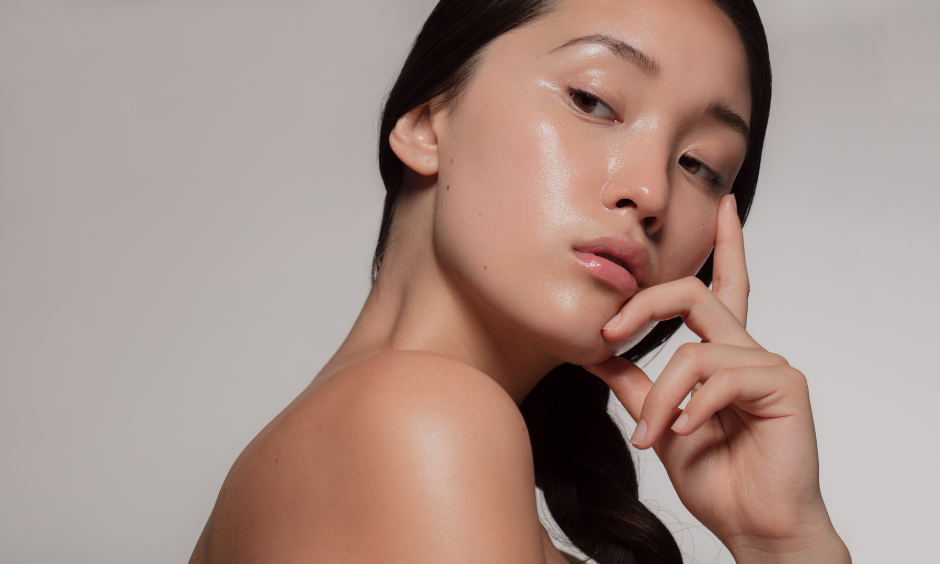
What is “glass skin” (in plain science)
“Glass skin” is just a name for a specific way skin reflects light. When the surface is very smooth, light bounces back evenly, so the face looks glossy and clear instead of matte.
That look mainly depends on three things:
- Surface film: the thin layer on top of skin (from sebum and skincare ingredients like silicones or oils) can spread light more evenly when it sits smoothly.“Glass skin” is a visual label for a particular pattern of specular reflection: light returns from the face in a smooth, continuous way with minimal visible scattering.
- Surface texture: flakes, tiny bumps, or rough patches break up the reflection and make skin look less “glassy.”
- Even tone: the more uniform your pigment and redness are, the more “clear” the glow looks.
If those three are optimized, the face reads as “glassy,” even if the deeper skin biology has not changed.
Glass skin vs dewy skin vs oily shine
| Look people name | What it usually is optically | What it often feels like | Common misread |
|---|---|---|---|
| Glass skin | High, continuous reflection with low visible scattering | Smooth, sometimes tacky | Interpreted as “perfect hydration” |
| Dewy skin | Softer reflection with some texture still visible | Supple, comfortable | Interpreted as “healthy barrier” |
| Oily shine | Uneven reflection with visible texture and pore shadowing | Slippery, greasy | Interpreted as “dirty” or “needs stripping” |
A useful way to think about it: glass is not just shiny. It is shiny in a uniform way. Skin becomes “glass” when the surface behaves like a more even optical sheet.
Fun fact: why it photographs so well
Cameras compress dynamic range and can exaggerate bright highlights relative to mid-tones. In many lighting setups, a small change in surface smoothness produces a large change in perceived glow. That is one reason “glass skin” spreads through video faster than it spreads through actual skin biology.
The biology behind the look (what is actually changing)
The skin feature that most strongly controls this look is the topmost layer of skin -stratum corneum. It is a functional barrier made of flattened corneocytes embedded in a lipid matrix. When its organisation changes, your skin’s water handling, irritation threshold, and surface optics change together.
Surface roughness: the “lens” on your face
A rougher surface scatters light in many directions, which reduces the sharpness of reflections. When the stratum corneum is dehydrated, corneocytes can lift at the edges and desquamation becomes more visible. That increases micro-roughness and you read it as “dull.”
When hydration improves and corneocytes lie flatter, the surface becomes more even. Light scattering decreases and specular reflection increases. You read it as “glow.”
This is why the same person can look “glass” at 8 a.m. after layering products, and more matte by lunch, without anything “going wrong.” The surface film and the outer hydration gradient have changed.
Why moisturisers can create instant glass skin
Moisturisers change optics through three families of ingredients. The biology here is not mysterious.
- Humectants (example: glycerol, hyaluronic acid) bind water and increase water content in the outer layers.
- Occlusives (example: petrolatum) reduce transepidermal water loss by forming a hydrophobic barrier.
- Emollients and silicones fill micro-gaps and smooth the surface, changing how light reflects.
This can produce a fast visual shift because reflectivity is surface-sensitive. That fast shift does not automatically mean long-term barrier improvement.
The inflammation trap: when “plump” gets mistaken for “healthy”
Mild irritation can increase redness and superficial swelling. Swelling can temporarily reduce visible micro-texture, which can look smoother in certain lighting. This is a common misread: irritation can briefly reduce visible texture by swelling the surface, while also lowering the irritation threshold.
Here is the decision rule I use clinically and personally:
If your glow is paired with stinging, burning, persistent redness, or a sudden increase in reactivity, you are not seeing improvement. You are seeing a stress response.
Why we obsess: this trend is about control, not just skin
Most skincare trends that survive for years do not survive because they are scientifically rigorous. They survive because they solve a psychological problem.
“Glass skin” solves the problem of uncertainty. Aging is slow, uneven, and not fully controllable. “Glass” offers a visible, immediate signal you can chase and reproduce on demand.
The health halo effect
Humans are strong signal-detectors. We associate even tone and smooth reflection with youth and high-functioning tissue, because those traits often co-occur in young, well-hydrated skin. The problem is that modern formulations can mimic that visual signal without producing the underlying stability.
That is why people become loyal to routines that are essentially optical styling systems. They deliver a daily reward.
Sensation becomes “proof”
Another reason the obsession persists is a sensory misunderstanding.
- Tackiness gets interpreted as hydration.
- Tingling gets interpreted as activity.
- Tightness after cleansing gets interpreted as cleanliness.
Biologically, these sensations often reflect nerve activation, surfactant effects, and surface chemistry, not barrier restoration.
Pro tip: If a routine feels “effective” because you can feel it, you are likely selecting for irritation risk. Barrier-supportive routines often feel uneventful because they minimize nerve activation and avoid aggressive surface disruption.
Platform physics: what wins on camera is not what wins on skin
Short-form video rewards immediate visible payoff, strong highlight contrast, and routines that layer neatly.
Those are not the same selection pressures as long-term barrier health, which rewards stability, tolerance, and reduced reactivity.
Where glass skin and real skin health diverge
“Glass skin” can happen in healthy skin. It can also happen in skin that is inflamed, over-exfoliated, or dependent on heavy surface films.
The divergence shows up when the trend teaches people to chase the look through escalating intensity.
The short-term cheat codes
Some common ways people create “glass” quickly:
- heavy occlusion on top of humectants
- high-slip silicones and film formers
- frequent exfoliation to reduce visible scale
These can be reasonable tools. The risk appears when they are used as a daily identity rather than an occasional styling choice.
Over-exfoliation: polishing the surface by thinning your tolerance
Exfoliants reduce corneocyte cohesion and increase desquamation. In the right context, that can improve the look of roughness.
In the wrong context, repeated exfoliation plus frequent cleansing plus aggressive actives can increase transepidermal water loss and lower irritation threshold. The result is a cycle:
- Skin looks smoother right after product layering.
- Skin becomes more reactive over time.
- More products get added to calm the reaction and recreate the highlight.
That cycle is one reason “glass skin” can become a long-term consumer trap.
A comparison worth making: styling outcomes vs stability outcomes
| Goal | What you can change fast | What takes time | What to watch for |
|---|---|---|---|
| Glass look | Surface film, micro-texture, camera lighting | Not required | Shine paired with stinging or redness suggests irritation |
| Barrier stability | Not much in a day | Weeks of consistent, tolerated care | Less reactivity, less tightness, more predictable baseline |
| Tone uniformity | Some cosmetic coverage and optical blur | Months with UV protection and inflammation control | Fewer new dark marks and less blotchy redness |
How to get the look safely, without turning your face into a lab experiment
“Glass skin” is easiest when you control two things at the same time: how smooth the skin surface is, and how evenly the thin layer on top of the skin sits, whether that layer comes from sebum or skincare.
The safest way to get there is to build baseline tolerance first, then add the products that create shine. Doing it in that order lowers the chance that your “glow” is actually coming from mild irritation and swelling rather than a calm, stable surface.
A helpful way to frame it is that the stratum corneum, your outermost layer, has two roles people often mix together. One role is barrier regulation, which means keeping water in and irritants out, and improvements here usually show up over weeks of consistent, non-irritating care. The other role is optics, which means changing how light reflects off the face, and that can shift in minutes because a smoother surface and a more even surface film reflect light more uniformly.
The core principle: stability beats intensity
Barrier stability depends on keeping the stratum corneum lipids and corneocyte cohesion within a workable range. Excess cleansing, too-frequent exfoliation, and stacking multiple strong actives can push the barrier toward higher water loss and higher nerve sensitivity. That combination often produces redness and stinging that people misread as “purging” or “skin getting used to it.”
A stability-first routine aims for predictable, low-variability skin days. That is the physiological foundation that makes any glow look cleaner.
A minimalist routine framework that still delivers shine
This framework is built on mechanisms rather than brand claims.
Morning
- Gentle cleanse or rinse
- Mechanism: fewer surfactant exposures means less lipid removal and less nerve activation.
- Hydrating layer (humectant-focused)
- Mechanism: increases water content in the upper stratum corneum, which reduces micro-roughness.
- Moisturizer (emollient + optional occlusive)
- Mechanism: smooths surface micro-gaps and slows water loss.
- Broad-spectrum sunscreen
- Mechanism: reduces UV-driven inflammation and pigment signaling that increases tone unevenness over time.
Night
- Gentle cleanse
- Mechanism: removes film and particles without unnecessary barrier disruption.
- Optional active, only if tolerated
- Mechanism: can improve texture and tone signals over time, but irritation is dose-related.
- Moisturizer as the baseline step
- Mechanism: sets a stable lipid and water environment before any active.
- Optional thin occlusive layer when needed
- Mechanism: increases water retention overnight when humidity is low or barrier is compromised.
Pro tip: Many people chase glow by adding steps. A more reliable route is to lower the number of steps you cannot tolerate, then repeat the steps you can tolerate daily.
Where actives help, and where people misdose them
Actives can improve the baseline that supports a smooth reflective surface, but the benefit depends on total irritation load.
| Active category | What it can improve over time | Main risk when chasing “glass” | A safer dosing mindset |
|---|---|---|---|
| Exfoliating acids | Roughness, visible scale | Barrier disruption from frequency | Think weekly, then adjust |
| Retinoids | Texture and uneven tone signaling | Irritation and sensitivity when escalated fast | Start low, move slowly |
| Vitamin C (topical) | Oxidative stress signaling, tone support | Irritation, instability depending on form | Choose tolerable formats |
The goal is not maximal stimulation. The goal is controlled input that your barrier can metabolise without turning reactive.
What to track instead of glow: metrics that match skin physiology
If you want a useful feedback system, track variables that correlate with barrier function and inflammation rather than highlights.
The stability checklist
| What to observe | Why it is informative biologically | What improvement looks like |
|---|---|---|
| Stinging with bland products | Nerve sensitivity and barrier compromise | Less stinging over weeks |
| Tightness after cleansing | Lipid loss and water gradient disruption | Less tightness, less urgency to moisturise |
| Redness volatility | Inflammatory reactivity | Fewer swings day to day |
| Texture volatility | Barrier instability and desquamation changes | Fewer “good day, bad day” cycles |
A simple self-test you can repeat
- Take one bare-skin photo per week in the same location and lighting.
- Write down, the same day, whether cleansing caused tightness, whether moisturizer caused stinging, and whether redness increased after heat or friction.
This gives you a trend line that does not depend on product sheen.
Fun fact: Many “glow” routines look strongest right after application because the surface film is at its most uniform then. The most useful question is what your skin looks and feels like at baseline, before product layering.
Conclusion: a more adult relationship with glow
The glass skin trend persists because it offers a fast visual reward that people interpret as health and self-control. Biologically, the look often comes from surface smoothing and a uniform film, which can be compatible with a healthy barrier. The risk appears when people try to force the look with escalating exfoliation, frequent cleansing, and stacked actives that increase irritation load.
If you want the aesthetic, the sensible path is to build baseline tolerance first, then layer optical shine on top.
Dr Bozica