

What Makes a Good Moisturiser? A Formulation Scientist Explains
Take two moisturisers with glycerine, hyaluronic acid and ceramides printed across the front. One keeps your skin comfortable for hours. The other feels lovely when you apply it, yet the tightness returns after half an hour.
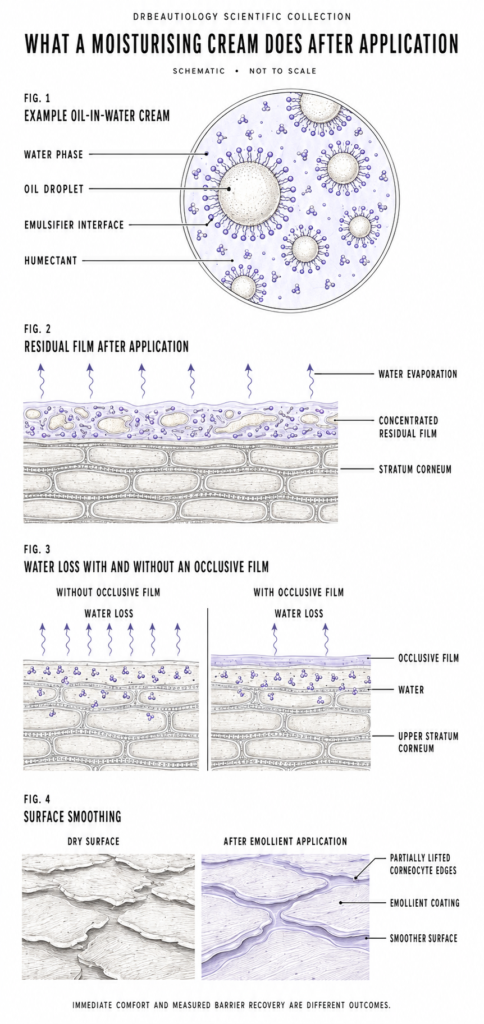
The difference usually comes from the complete formula. Concentration and emulsion structure influence how the cream spreads. They also influence the film that remains as its water begins to evaporate. That film can feel light, greasy, sticky or almost imperceptible, and it helps control how quickly water continues to leave the skin.
This is where ingredient checklists become unreliable. A label confirms which materials went into the product. Their percentages and arrangement inside the emulsion usually stay hidden. Finished-product behaviour only becomes clear once the cream is applied to skin.
As a formulation scientist, I use the ingredient list to form a hypothesis. Then I pay attention to what happens after application. How long does the comfort last? Do fine flakes begin to soften after several days? Does the product sting, or leave a heavy film over skin that still feels tight?
Those observations explain why products with similar claims behave differently. If your skin feels dry again soon after moisturising, the formula may be leaving too little protection from evaporation. Irritation from the moisturiser, cleanser or active products can produce a similar feeling, especially when tightness comes with stinging or redness.
What makes a good moisturiser?
A good moisturiser keeps the stratum corneum, the outermost layer of skin, hydrated enough to remain flexible and comfortable between normal applications. It does this by combining water binding with surface lubrication and some control over evaporation. The balance changes with your skin, the weather and the rest of your routine.
Softer skin after application shows that the cream is moisturising. Barrier recovery is a separate outcome. Researchers assess it by disrupting the barrier under controlled conditions and measuring how quickly its function returns after treatment with the finished product.
What dry skin needs from a moisturiser
The stratum corneum is built from flattened cells called corneocytes, surrounded by organised layers of lipids. Water-binding compounds sit inside the cells, while the surrounding lipids slow the movement of water towards the surface.
As its water content falls, this layer becomes less flexible. Corneocytes separate and shed unevenly, so the surface feels rough and fine flakes become visible. Changes in the surrounding lipids can allow water to escape more readily and leave skin more reactive to products that previously felt comfortable. I explain that process in Dry Skin 101 (Mawazi et al., 2022; Chandan et al., 2021).
Moisturisers address these changes through three overlapping formulation functions.
| What the formula needs to do | How it helps the outer skin | Ingredients you may see | What you may notice |
|---|---|---|---|
| Increase water binding | Humectants hold water within the product and upper stratum corneum | Glycerine, urea, panthenol, hyaluronic acid, sodium PCA | Skin feels less tight and bends more comfortably |
| Smooth the surface | Emollients spread over rough corneocytes and reduce friction | Squalane, triglycerides, esters, fatty alcohols, shea butter | Flakes feel softer and the surface feels smoother |
| Slow evaporation | Occlusives leave a water-resistant film | Petrolatum, mineral oil, dimethicone, waxes | Comfort lasts longer between applications |
Most creams contain ingredients that contribute to more than one row. The final effect comes from the complete emulsion, including the amount applied and how evenly it spreads.
How to read a moisturiser ingredient list in Australia
Australian cosmetic labels follow the Consumer Goods (Cosmetics) Information Standard 2020. Ingredients at one percent or more may be listed in descending order by mass or volume. Those below one percent can then appear in any order, followed by colour additives (ACCC, 2026). This makes the beginning of the list most informative about the product’s broad structure.
Water at the top is expected in most creams and lotions. It carries water-soluble ingredients such as glycerine or urea. Emulsifiers keep the oil distributed through this water phase, while thickeners control spreading and stability. A water-containing formula also needs preservation against microbial contamination during use (Mawazi et al., 2022).
When I turn over a moisturiser, I look first for ingredients likely to bind water and for the materials that may remain on the skin as a film. Fragrance and any allergens relevant to the person using it come next. Featured extracts interest me only after the base formula makes sense for the dryness I am trying to manage.
| What appears on the label | What you can reasonably infer | What remains hidden |
| Glycerine near the beginning | The formula probably has a meaningful humectant component | Its percentage and the size of any measured hydration effect |
| Petrolatum or mineral oil high on the list | The product is likely to leave a stronger water-resistant film | How that film feels and how much it slows water loss |
| Ceramides with cholesterol and fatty acids | Several physiological lipid classes were included | Their proportions, physical organisation and performance in human skin |
| Several forms of hyaluronic acid | Different molecular grades or modifications were used | Their combined amount and contribution to the finished product |
| Several botanical extracts near the end | The formula contains multiple extracts, often at low individual levels | Their stability and delivered amount within that formula |
The ingredient list helps you avoid a known allergen and compare the broad structure of two products. Treat it as the beginning of the assessment, because two familiar-looking lists can still create very different creams.
Humectants increase water binding in the outer skin
Humectants contain chemical groups that interact with water. Inside a moisturiser, they help retain water within the formula and the upper stratum corneum. Glycerine, urea and hyaluronic acid all perform this role, although they behave differently in a finished product.
Why glycerine remains one of my first choices
Glycerine rarely receives the attention given to newer humectants, yet I am usually pleased to see it near the beginning of a moisturiser’s ingredient list. Research links it with increased stratum-corneum hydration and more orderly shedding of corneocytes, which helps explain its effect on tightness and fine scaling (Fluhr et al., 2008).
Higher concentrations can feel sticky. Formulators change the oil phase and texture modifiers to reduce that tack, so the same ingredient can feel completely different across two products. My guide to glycerine in skincare explains this in more detail.
Urea changes as the concentration rises
Urea forms part of the skin’s natural water-binding system. At lower concentrations, it mainly supports hydration and shedding of dry surface cells. Higher concentrations loosen compacted keratin more strongly, which suits thick heels and elbows better than an irritated face. Stronger products can also sting when they reach a crack or inflamed area (Celleno, 2018; Piquero-Casals et al., 2021).
Pro tip: Check the urea percentage before deciding where the product belongs. Choose a lower-strength moisturiser for ordinary facial or body dryness. Keep stronger formulas for intact, thickened skin and follow the areas named on the label. My article on how urea changes dry, damaged skin explains the concentration ranges in more detail.
Hyaluronic acid needs more context than molecular weight
Hyaluronic acid comes in different molecular sizes and chemical modifications. Molecular weight affects where it remains in the upper skin and how the film behaves as the product dries.
One frequently quoted study applied one-percent solutions of three molecular weights to excised human skin. The researchers detected smaller molecules farther beyond the stratum corneum, while the largest remained closer to the surface (Essendoubi et al., 2016). The experiment mapped location inside excised skin. Comfort and hydration from a finished serum fell outside its design.
The familiar claim that hyaluronic acid holds 1,000 times its weight in water offers little help at the shelf. Water binding changes with molecular weight, concentration and testing conditions. My hyaluronic acid guide looks more closely at what those differences mean inside a finished product.
Why a humectant serum can still leave skin tight
A popular explanation says that humectants draw water from deeper skin in dry air and eventually make the surface drier. Reviews repeat the idea, although direct human evidence showing this outcome from a properly formulated leave-on moisturiser remains sparse (Mawazi et al., 2022).
A watery serum can still feel inadequate during a Perth summer or under strong air conditioning. Its thin remaining film may provide little resistance to further water loss, and some polymers tighten as they dry. Recent cleansing or an irritating active can add to the same sensation.
Pro tip: Apply the serum beneath a lotion or cream for several days and leave the rest of the routine unchanged. Longer-lasting comfort suggests that the extra surface film helped. Continued tightness with stinging gives you a reason to examine the serum, cleanser and active products more closely.
PHOTO QUOTE 1
“An impressive ingredient list can still produce an unimpressive moisturiser.”
Emollients change how rough skin feels
Emollients spread across uneven corneocytes and reduce friction, so dry skin can feel smoother before visible flakes have fully settled. Squalane, triglycerides and cosmetic esters can provide this slip. Plant oils and fatty alcohols contribute as well, with textures ranging from light and silky to dense and waxy.
Human sebum contains squalene. Skincare usually contains squalane, its hydrogenated and more oxidation-resistant relative. Squalane gives softness and slip, while its concentration and the surrounding emulsion influence how much the product slows water loss (Kim and Karadeniz, 2012).
Cetyl alcohol, stearyl alcohol and cetearyl alcohol are fatty alcohols used to thicken emulsions and create a soft film. Their chemistry and function differ from volatile alcohols such as ethanol, so read the complete ingredient name.
Plant oils need the same chemical precision. Linoleic acid contributes to epidermal lipid biology. Free oleic acid can disturb stratum-corneum organisation and is used in drug-delivery research as a penetration enhancer. In a small human study, repeated application of neat olive oil reduced stratum-corneum integrity and caused mild redness (Danby et al., 2013).
The participants used undiluted olive oil repeatedly. An emulsion containing a smaller amount creates a different exposure. The practical lesson is to examine which oil was used and how much the emulsion contains.
Occlusives help moisturising effects last
Water continually moves from deeper tissue towards the skin surface. Occlusive ingredients slow its final movement into the air, allowing more water to remain in the stratum corneum.
Petrolatum is exceptionally effective at forming a water-resistant film. It can increase hydration without a conventional humectant because it reduces evaporation so strongly (Ghadially et al., 1992). Mineral oil, dimethicone and waxes perform the same general function, with results shaped by their concentration and distribution through the product.
Petrolatum may be the least glamorous ingredient in the bathroom cabinet. Formulation chemistry has survived greater insults. For dry patches around the nose or lips, a thin layer over a cream you already tolerate can extend comfort.
Occlusion and pore blockage describe separate properties. Acne suitability depends on the complete formula and your individual response. Texture still deserves attention because regular application is needed for benefit.
In dry air or after repeated hand washing, a light film can disappear quickly. A more substantial cream or ointment may maintain comfort for longer, provided its texture still encourages regular use.
Moisturising and barrier recovery answer different questions
Immediate moisturising and barrier recovery often appear inside the same product claim. They describe different outcomes.
A cream can reduce water loss as soon as its film forms, so skin may feel softer within minutes. Barrier recovery asks whether barrier function returns more quickly after disruption. Researchers assess that under controlled conditions, often by tracking water loss over time.
| Outcome | What you may notice | What the observation supports |
| Immediate moisturising | Skin feels softer and less tight after application | The formula added water, softened the surface or reduced evaporation while present |
| Better daily control of dryness | Scaling reduces and comfort lasts longer with repeated use | The routine is managing dryness more effectively |
| Measured barrier recovery | A controlled study records faster recovery after disruption | The tested formula improved that measurement under the study conditions |
Ceramides, cholesterol and free fatty acids are major lipid classes in the stratum corneum. Their inclusion has a sound biological rationale. Advice about one perfect ratio rests on much narrower evidence.
The influential 1996 ratio study used acutely disrupted skin in hairless mice (Man et al., 1996). A later experiment studied aged mice and six older adults after tape stripping. The researchers delivered the lipids in propylene glycol and propanol, which is far removed from ordinary use of a face cream (Zettersten et al., 1997).
The lipid proportions affected recovery in those models. Translating the result into a universal shopping ratio would require larger human studies on complete moisturisers used under ordinary conditions.
A 2024 review discusses how lipid processing and layered organisation inside a cream may influence performance (Schild et al., 2024). Several authors worked for Evonik, a supplier of cosmetic ingredients. The proposed mechanisms are plausible. A brand can support its performance claim with human testing of its finished cream.
Ceramide NP on a label confirms that ceramide NP was added. Its concentration and arrangement within the emulsion remain unknown. When a brand claims barrier recovery, look for human testing of the complete cream. My article on ceramides in skincare examines this evidence in detail.
Choose a moisturiser by what your skin is doing
Dry, oily and combination skin are broad starting points. More specific clues come from what you feel, when it begins and which products touched the same area.
| What you experience | What may be contributing | A sensible next comparison |
| Tightness returns soon after application | The formula may leave too little film, the amount may be small, or another product may be irritating | Compare it with a lotion or cream that leaves a more substantial film while keeping the rest of the routine stable |
| Skin feels greasy and tight | An oily or polymer film may sit over poorly hydrated or irritated skin | Try a lotion with glycerine and some dimethicone or mineral oil; reduce irritating actives if the area also stings |
| Flakes collect around the nose or mouth | Repeated wiping, limited surface protection or dermatitis may contribute | Use a fragrance-free cream on the area and add a thin layer of petrolatum if comfortable |
| A rich cream feels unpleasant on acne-prone skin | The texture may discourage regular use, or one component may contribute to breakouts for you | Test a lighter lotion or gel cream and introduce one product at a time |
| Moisturiser stings on contact | Inflamed or fissured skin can react to urea, acids, fragrance, solvents or preservatives | Stop the product and return to a fragrance-free formula previously tolerated; seek assessment if burning continues |
| Heels or elbows remain thick and rough | Compacted surface keratin may respond better to a keratolytic moisturiser | Choose a body product with a stated urea percentage and use stronger concentrations on intact, thickened skin |
Change one part of the routine at a time. If a richer cream extends comfort without creating another problem, the earlier formula probably offered too little lasting film for those conditions. When several products sting in the same area, examine the cleanser, active products and moisturiser for possible irritants.
Persistent itch, a visible rash, painful cracks, bleeding or steadily worsening dryness deserves medical assessment. The American Academy of Dermatology notes that ongoing dryness can reflect an underlying condition, medication or something the skin contacts during the day (American Academy of Dermatology, 2026).
Optional ingredients need a specific purpose
Niacinamide, colloidal oatmeal and antioxidants may add a targeted function when their concentration and formulation support it. The base formula still carries the main responsibility for everyday dryness.
A study in people with rosacea reported improvement after four weeks with a niacinamide-containing moisturiser (Draelos et al., 2005). Because the researchers tested a complete product, the result supports that formula as a whole. P&G funded the study, and two authors were employees and shareholders. If niacinamide makes your skin feel hot or causes stinging, my article on niacinamide flushing and irritation explains several possible reasons.
Colloidal oatmeal has a defined role in the United States over-the-counter skin-protectant monograph. Products meeting the monograph can carry claims about temporary relief of minor irritation and itching associated with eczema (FDA, 2021). An oat extract in a cosmetic moisturiser may have a different composition and regulatory status, so read the claim attached to the finished product.
Antioxidants raise another formulation question. Tocopherol may protect the cream’s oils from oxidation during storage. An effect inside skin also depends on stability and delivery in a sufficient amount. When that is your main reason for buying the product, look for research on the finished formula. My article on antioxidant serums and oxidative stress examines the delivery question in more detail.
Application changes how a moisturiser performs
Applying moisturiser after washing is sensible because cleansing can leave dry skin uncomfortable. The familiar three-minute rule sounds more precise than the research behind it.
One crossover study compared immediate application with application after a thirty-minute delay in healthy young adults. Both treated areas showed greater hydration and lower water loss than untreated skin during the short follow-up, and the two application times performed similarly (Nguyen et al., 2022).
The researchers tested one moisturiser on healthy skin for only a few hours. Applying soon after washing remains convenient, especially when skin already feels tight. In this experiment, waiting thirty minutes produced a similar short-term result.
Use enough product to cover the area evenly. Hands need another layer after washing because water and surfactants remove part of the surface film. On the face, a lighter lotion used regularly may serve you better than a rich cream that spends most of its life in the bathroom cabinet.
Drinking extra water is often suggested for dry skin. One study in healthy women reported higher hydration measurements after they added two litres of water each day for a month, especially among women who previously drank less. The study had no untreated comparison group, so changes unrelated to the extra water could have contributed (Palma et al., 2015). I examine the wider evidence in Does Drinking More Water Really Hydrate Your Skin?.
How the complete formula shapes moisturiser performance
A moisturiser is sold through its featured ingredients, then used as a complete emulsion. That difference changes how I assess it.
The ingredient list helps me predict the broad structure. I then watch the skin over the following hours and days. Lasting comfort suggests that the formula is supplying enough hydration and surface protection for the current conditions. Softer scaling after repeated use shows better control of dryness. Stinging or increasing redness sends me back to the cleanser, active products and moisturiser itself to look for a possible irritant.
The answer may change with the season, repeated hand washing or an active treatment. A face, a pair of hands and a cracked heel rarely ask the same cream to do the same job.
Once you compare products this way, a plain glycerine cream that keeps your skin comfortable for six hours stops looking inferior to an ingredient-packed cream that lasts for one. Its performance has a formulation explanation, even when most of that explanation stays hidden from the label.
Have you used two moisturisers with similar headline ingredients and had completely different results? Tell me what your skin felt like after application and a few hours later. Those details are often where the formulation story begins.
Talk to you soon!
Dr Bozica
References
- Mawazi SM, et al. A Review of Moisturizers: History, Preparation, Characterization and Applications. Cosmetics. 2022;9(3):61.
- Chandan N, Rajkumar JR, Shi VY, Lio PA. A New Era of Moisturizers. Journal of Cosmetic Dermatology. 2021;20(8):2425-2430.
- Fluhr JW, Darlenski R, Surber C. Glycerol and the Skin: Holistic Approach to Its Origin and Functions. British Journal of Dermatology. 2008;159(1):23-34.
- Celleno L. Topical Urea in Skincare: A Review. Dermatologic Therapy. 2018;31(6).
- Piquero-Casals J, et al. Urea in Dermatology: A Review of Its Emollient, Moisturizing, Keratolytic, Skin Barrier Enhancing and Antimicrobial Properties. Dermatology and Therapy. 2021;11:1905-1915.
- Essendoubi M, et al. Human Skin Penetration of Hyaluronic Acid of Different Molecular Weights as Probed by Raman Spectroscopy. Skin Research and Technology. 2016;22(1):55-62.
- Ghadially R, Halkier-Sørensen L, Elias PM. Effects of Petrolatum on Stratum Corneum Structure and Function. Journal of the American Academy of Dermatology. 1992;26(3 Pt 2):387-396.
- Kim SK, Karadeniz F. Biological Importance and Applications of Squalene and Squalane. Advances in Food and Nutrition Research. 2012;65:223-233.
- Danby SG, et al. Effect of Olive and Sunflower Seed Oil on the Adult Skin Barrier. Pediatric Dermatology. 2013;30(1):42-50.
- Man MQ, et al. Optimization of Physiological Lipid Mixtures for Barrier Repair. Journal of Investigative Dermatology. 1996;106(5):1096-1101.
- Zettersten EM, et al. Optimal Ratios of Topical Stratum Corneum Lipids Improve Barrier Recovery in Chronologically Aged Skin. Journal of the American Academy of Dermatology. 1997;37(3 Pt 1):403-408.
- Schild J, et al. The Role of Ceramides in Skin Barrier Function and the Importance of Their Correct Formulation for Skincare Applications. International Journal of Cosmetic Science. 2024;46(4):526-543.
- Australian Competition and Consumer Commission. Cosmetics Ingredients Labelling Mandatory Standard. Accessed August 2026.
- Draelos ZD, Ertel K, Berge C. Niacinamide-Containing Facial Moisturizer Improves Skin Barrier and Benefits Subjects With Rosacea. Cutis. 2005;76(2):135-141.
- US Food and Drug Administration. OTC Monograph M016: Skin Protectant Drug Products for OTC Human Use. 2021.
- Nguyen KH, et al. Moisturizing Effectiveness of Immediate Compared With Delayed Moisturization. Journal of Cosmetic Dermatology. 2022;21(10):5134-5140.
- American Academy of Dermatology. Dry Skin: Overview. Accessed August 2026.
- Palma L, Marques LT, Bujan J, Rodrigues LM. Dietary Water Affects Human Skin Hydration and Biomechanics. Clinical, Cosmetic and Investigational Dermatology. 2015;8:413-421.
Quick q—what’s the best mix if I have oily but dehydrated skin? I always get confused with occlusives vs emollients.
Hi Mira! Focus on light formulations with glycerine or hyaluronic acid. These hydrate without adding oil. For emollients look for squalene and light oils (like rosehip, jojoba, grapeseed). Avoid coconut/ avocado oils. it’s best to avoid heavy occlusive, like mineral oils, petrolatum, paraffin, Cera Microcristallina/Microcrystalline Wax.
This is SO helpful. I’ve been buying moisturizers just based on texture 😅 time to start actually reading ingredient labels!