
Vitamin C deserves a place in your skincare routine.
Topical vitamin C supports collagen, helps skin deal with UV-driven oxidative stress, and can improve some signs of photodamage over time. It can also disappoint very quickly when the formula is unstable, irritating, or poorly packaged.
That split explains why vitamin C gets praised, dismissed, and misunderstood in equal measure.
The molecule is fine. The formula is the issue.

- What vitamin C does for skin
- Who vitamin C helps most
- Who should be careful
- What a good vitamin C formula looks like
- Common myths about vitamin C serums
- How to buy a vitamin C serum with more confidence
- FAQ: Vitamin C in skincare
- What does vitamin C do for skin?
- Does vitamin C help collagen?
- Does vitamin C help with glow?
- Does vitamin C help with melasma?
- How can you tell if a vitamin C serum has oxidised?
- Should a vitamin C serum be orange?
- Is a clear bottle a bad sign for vitamin C?
- Is higher percentage vitamin C better?
- Are vitamin C derivatives as good as L-ascorbic acid?
- Can vitamin C irritate skin?
- Final thoughts
- What vitamin C does for skin
- Who vitamin C helps most
- Who should be careful
- What a good vitamin C formula looks like
- Common myths about vitamin C serums
- How to buy a vitamin C serum with more confidence
- FAQ: Vitamin C in skincare
- What does vitamin C do for skin?
- Does vitamin C help collagen?
- Does vitamin C help with glow?
- Does vitamin C help with melasma?
- How can you tell if a vitamin C serum has oxidised?
- Should a vitamin C serum be orange?
- Is a clear bottle a bad sign for vitamin C?
- Is higher percentage vitamin C better?
- Are vitamin C derivatives as good as L-ascorbic acid?
- Can vitamin C irritate skin?
- Final thoughts

Topical vitamin C supports collagen, helps skin deal with UV-driven oxidative stress, and can improve some signs of photodamage over time.
It can also disappoint very quickly when the formula is unstable, irritating, or poorly packaged.
What vitamin C does for skin
Vitamin C supports collagen
Collagen helps skin stay firm and resilient. Vitamin C supports the enzymes that shape collagen into a stable form the skin can actually use.
That link gives vitamin C a strong scientific basis in anti-ageing skincare. In human studies on photodamaged skin, researchers saw smoother texture, softer fine wrinkles, and biopsy changes linked to collagen and elastic fibres.
You should still keep expectations sensible. A vitamin C serum will not remodel deeply set lines or lift sagging skin. It can support skin that looks rougher, thinner, duller, or more lined after years of sun exposure.
Vitamin C helps skin deal with UV-related stress
UV light generates unstable molecules (free radicals) that damage skin over time. That damage shows up as rough texture, patchy tone, fine lines, and a tired-looking surface.
Vitamin C helps neutralise some of that oxidative stress. That is one reason it keeps turning up in research on photoageing and uneven pigmentation.
Vitamin C can improve uneven tone
Vitamin C has a credible role in pigment care. It can influence pathways involved in melanin production, and clinical studies show improvement in melasma and solar lentigines.
The pace is often slower than people expect. In several studies, instrument readings showed pigment improvement more clearly than doctor ratings or self-ratings. Skin may be shifting before the mirror gives you much to work with, therefore results with vitamin C may be slower than some other brightining agents (check out more on Best Active Ingredients for Uneven Skin Tone).
What people usually mean by “glow”
Glow is vague. In practice, people usually mean smoother texture, less sallowness, more even tone, and a surface that reflects light more evenly. That lines up well with the clinical data. A brighter-looking complexion often comes from better texture and more even colour.
Where claims often go too far
Vitamin C earns credit for collagen support, photodamage care, and some pigment improvement. It does not deserve to be treated as the answer to every skin concern.
Hydration improved in both active and placebo-treated skin in controlled studies. Regular skincare use likely explained that shift better than vitamin C itself. So to get most out vitamin C, keep your focus on texture, fine wrinkling, uneven tone, and support for skin under oxidative stress.
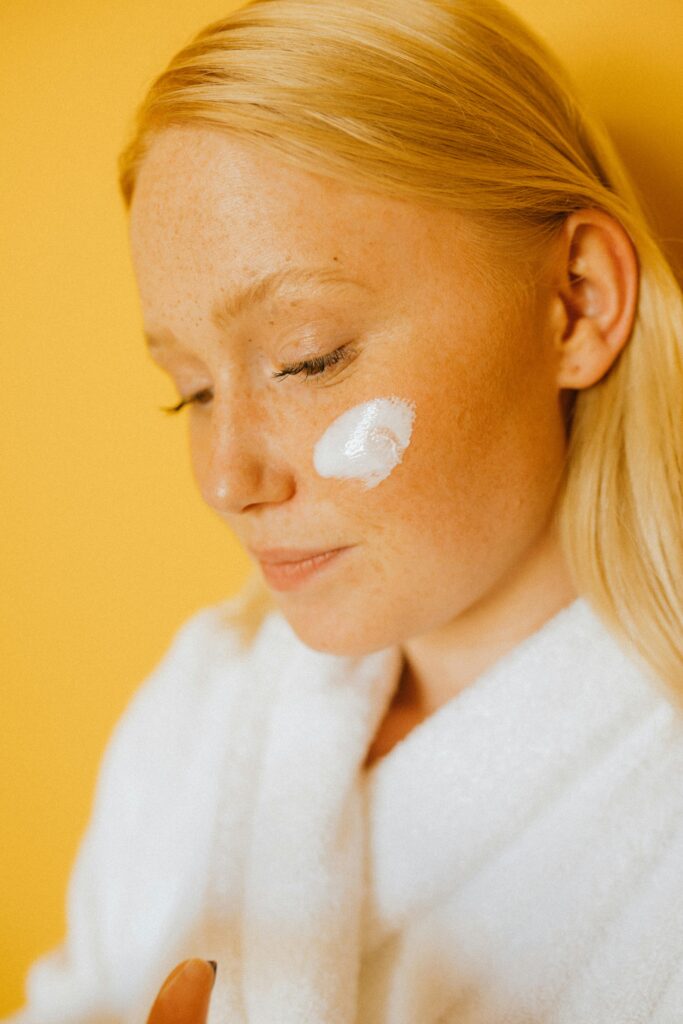
You should still keep expectations sensible. A vitamin C serum will not remodel deeply set lines or lift sagging skin.
Who vitamin C helps most
Skin with signs of photoageing
This is where the evidence looks strongest.
Photoaged skin often looks rougher, duller, and less even. Fine lines show more clearly. The surface loses some of its smoothness. Topical vitamin C has the clearest support here, especially for texture, small wrinkles, and tone.
Skin that looks flat, tired, or slightly sallow
Vitamin C can suit skin that needs a fresher-looking surface rather than a dramatic overhaul.
Over time, you may see smoother texture, softer fine lines, and a brighter-looking complexion. That shift usually comes from better surface quality and more even tone.
Uneven tone
Vitamin C can help with patchy tone, melasma, and solar lentigines, though it rarely gives the fastest visible change.
In split-face melasma research, hydroquinone produced faster and stronger visible improvement. Vitamin C still improved pigment measurements and caused fewer adverse effects. That makes vitamin C a reasonable choice for gradual support, especially when tolerance is part of the decision.
Who should be careful
Skin that stings easily
Some vitamin C formulas sting because they are acidic. Others sting because the skin barrier is already irritated. Sometimes both are going on.
If your skin reacts easily, low-pH ascorbic acid can be a rough fit. A mild sting does not prove better efficacy. It often tells you the formula is irritating.
Anyone buying by percentage alone
A big number on the front of the box does not guarantee a better product.
Controlled trials mostly used concentrations below 10%, with limited data at 20%. This is not a simple “more percentage, more results” story. In an 8-week study on eye wrinkles, a vitamin C derivative improved the area across concentrations, and even the lower strengths still showed worthwhile changes in measures linked to dermal structure.
A huge percentage paired with poor stability is still a weak formula.
Anyone looking at device-assisted delivery
Laser, iontophoresis, ultrasound, and similar approaches may improve delivery into skin. The evidence base is still small and uneven.
One laser-assisted melasma study looked promising in the short term. That same approach has also been linked elsewhere with hypopigmentation, rebound hyperpigmentation, and ochronosis. Enhanced delivery can help, though it does not wipe away trade-offs.
What a good vitamin C formula looks like
Start with the form of vitamin C
L-ascorbic acid has the clearest support for collagen-related activity. It is also the hardest form to keep stable in a water-based formula.
Derivatives such as sodium ascorbyl phosphate, magnesium ascorbyl phosphate, ascorbyl glucoside, and lipid-soluble precursors can be easier to formulate. They do not all behave the same way on skin, and they do not all have the same level of clinical support. Some still need to convert into ascorbic acid in the skin before they can do the job people expect.
That is why two products labelled “vitamin C” can perform very differently.
Stability comes first
This is where weak formulas usually give themselves away.
L-ascorbic acid breaks down with light, air, heat, higher pH, and certain metals. When that happens, the active content drops and the formula becomes less useful. Orange or brown discolouration often goes hand in hand with oxidation and lower performance.

If the bottle is transparent, I am already less impressed. If the liquid is orange or brown, trust me, it is not only a cute design choice. Packaging should protect the active.
Delivery has to make sense
Skin has a strong outer barrier. That barrier keeps water in and a lot of outside material out.
Vitamin C is water-soluble and charged, which makes it hard to move through that barrier. That is why pH, solvent system, and delivery design carry so much weight. A formula needs to keep the active stable and give it a plausible path into skin.
Skin tolerance still counts
A formula can preserve the active and still be miserable to use.
A competent vitamin C product should protect the ingredient, help it reach skin in a useful way, and keep irritation as low as possible while the active still has a chance to work. Formulators have to balance stability, delivery, and comfort. That balance is hard to get right.
Combination formulas can be smart
Vitamin C can work well with vitamin E. Ferulic acid can improve stability and photoprotective performance in some systems.
Common myths about vitamin C serums
“All vitamin C is the same”
Free ascorbic acid and vitamin C derivatives differ in stability, pH needs, delivery, and likely skin behaviour.
That is why a derivative serum cannot automatically be treated as interchangeable with a well-formulated L-ascorbic acid product.
“A higher percentage means a better serum”
That shortcut falls apart quickly.
The clinical evidence at very high strengths is thinner than marketing suggests, and absorption appears to peak rather than rising indefinitely. A smart formula at a sensible concentration can outperform a louder one.
“If it stings, it’s working”
Stinging does not prove superior efficacy.
Sometimes the formula is simply too irritating for your skin.
“If it turns orange, it still works fine”
Oxidation lowers active content and usually signals a formula moving in the wrong direction.
A serum that has turned orange or brown deserves scepticism.
“Vitamin C is a moisturiser”
Controlled studies do not give vitamin C a clear edge here.
Regular use of skincare can improve hydration on its own, and that likely explains a good share of the change seen in trials.
“Vitamin C replaces sunscreen”
Vitamin C can support photoprotection, especially in combination with other antioxidants. Sunscreen still does the heavy lifting.
How to buy a vitamin C serum with more confidence
Start with the basics.
Look at the form of vitamin C. Check whether the packaging protects the formula from light and air. Pay attention to the colour of the liquid. Think about whether the formula seems designed for both stability and skin tolerance.
Then look at the claims.
If the product promises firmer, smoother, more even-looking skin over time, that sits within range. If it promises to do everything under the sun, move on.
You do not need to become a cosmetic chemist in the skincare aisle.
FAQ: Vitamin C in skincare
What does vitamin C do for skin?
Topical vitamin C supports collagen production, helps skin deal with oxidative stress from UV exposure, and can improve some signs of photodamage such as rough texture, fine wrinkles, and uneven tone.
Does vitamin C help collagen?
Yes. Vitamin C supports enzymes involved in collagen formation, which is one reason it appears so often in anti-ageing skincare.
Does vitamin C help with glow?
It can improve the look people often describe as glow by smoothing texture, reducing sallowness, and making skin tone look more even.
Does vitamin C help with melasma?
It can help, though progress is often gradual. In comparative research, hydroquinone improved visible melasma faster, while vitamin C showed some pigment benefit with fewer adverse effects.
How can you tell if a vitamin C serum has oxidised?
A shift towards orange or brown is a poor sign. Oxidation often goes hand in hand with lower active content and reduced performance.
Should a vitamin C serum be orange?
Generally, no. Visible orange or brown discolouration raises concern that the active has oxidised.
Is a clear bottle a bad sign for vitamin C?
It can be. Light exposure can speed up degradation, so transparent packaging is not a reassuring choice for a light-sensitive active.
Is higher percentage vitamin C better?
Not automatically. A higher percentage does not guarantee better delivery, better stability, or better results.
Are vitamin C derivatives as good as L-ascorbic acid?
Some are easier to formulate and may suit certain products well, though they do not all have the same level of evidence or the same behaviour on skin.
Can vitamin C irritate skin?
Yes. This is more likely with low-pH ascorbic acid formulas or when the skin barrier is already irritated.
Final thoughts
Vitamin C deserves more respect than the usual “glow ingredient” label suggests. It has a credible biological role in skin and a decent clinical signal for photodamage, collagen support, and uneven tone.
It also demands competent formulation.
That is where a lot of disappointment starts. A poor formula can waste a good ingredient very quickly. Once you see that clearly, vitamin C becomes much easier to judge.
Thanks for reading.
What vitamin C products do you use, and what would you add or want explained next?
If you want skincare explained by a scientist who actually formulates, follow my page. I publish new evidence-based breakdowns every week.
Dr Bozica
Vitamin C deserves a place in your skincare routine.
Topical vitamin C supports collagen, helps skin deal with UV-driven oxidative stress, and can improve some signs of photodamage over time. It can also disappoint very quickly when the formula is unstable, irritating, or poorly packaged.
That split explains why vitamin C gets praised, dismissed, and misunderstood in equal measure.
The molecule is fine. The formula is the issue.
- What vitamin C does for skin
- Who vitamin C helps most
- Who should be careful
- What a good vitamin C formula looks like
- Common myths about vitamin C serums
- How to buy a vitamin C serum with more confidence
- FAQ: Vitamin C in skincare
- What does vitamin C do for skin?
- Does vitamin C help collagen?
- Does vitamin C help with glow?
- Does vitamin C help with melasma?
- How can you tell if a vitamin C serum has oxidised?
- Should a vitamin C serum be orange?
- Is a clear bottle a bad sign for vitamin C?
- Is higher percentage vitamin C better?
- Are vitamin C derivatives as good as L-ascorbic acid?
- Can vitamin C irritate skin?
- Final thoughts
- What vitamin C does for skin
- Who vitamin C helps most
- Who should be careful
- What a good vitamin C formula looks like
- Common myths about vitamin C serums
- How to buy a vitamin C serum with more confidence
- FAQ: Vitamin C in skincare
- What does vitamin C do for skin?
- Does vitamin C help collagen?
- Does vitamin C help with glow?
- Does vitamin C help with melasma?
- How can you tell if a vitamin C serum has oxidised?
- Should a vitamin C serum be orange?
- Is a clear bottle a bad sign for vitamin C?
- Is higher percentage vitamin C better?
- Are vitamin C derivatives as good as L-ascorbic acid?
- Can vitamin C irritate skin?
- Final thoughts

Topical vitamin C supports collagen, helps skin deal with UV-driven oxidative stress, and can improve some signs of photodamage over time.
It can also disappoint very quickly when the formula is unstable, irritating, or poorly packaged.
What vitamin C does for skin
Vitamin C supports collagen
Collagen helps skin stay firm and resilient. Vitamin C supports the enzymes that shape collagen into a stable form the skin can actually use.
That link gives vitamin C a strong scientific basis in anti-ageing skincare. In human studies on photodamaged skin, researchers saw smoother texture, softer fine wrinkles, and biopsy changes linked to collagen and elastic fibres.
You should still keep expectations sensible. A vitamin C serum will not remodel deeply set lines or lift sagging skin. It can support skin that looks rougher, thinner, duller, or more lined after years of sun exposure.
Vitamin C helps skin deal with UV-related stress
UV light generates unstable molecules (free radicals) that damage skin over time. That damage shows up as rough texture, patchy tone, fine lines, and a tired-looking surface.
Vitamin C helps neutralise some of that oxidative stress. That is one reason it keeps turning up in research on photoageing and uneven pigmentation.
Vitamin C can improve uneven tone
Vitamin C has a credible role in pigment care. It can influence pathways involved in melanin production, and clinical studies show improvement in melasma and solar lentigines.
The pace is often slower than people expect. In several studies, instrument readings showed pigment improvement more clearly than doctor ratings or self-ratings. Skin may be shifting before the mirror gives you much to work with, therefore results with vitamin C may be slower than some other brightining agents (check out more on Best Active Ingredients for Uneven Skin Tone).
What people usually mean by “glow”
Glow is vague. In practice, people usually mean smoother texture, less sallowness, more even tone, and a surface that reflects light more evenly. That lines up well with the clinical data. A brighter-looking complexion often comes from better texture and more even colour.
Where claims often go too far
Vitamin C earns credit for collagen support, photodamage care, and some pigment improvement. It does not deserve to be treated as the answer to every skin concern.
Hydration improved in both active and placebo-treated skin in controlled studies. Regular skincare use likely explained that shift better than vitamin C itself. So to get most out vitamin C, keep your focus on texture, fine wrinkling, uneven tone, and support for skin under oxidative stress.

You should still keep expectations sensible. A vitamin C serum will not remodel deeply set lines or lift sagging skin.
Who vitamin C helps most
Skin with signs of photoageing
This is where the evidence looks strongest.
Photoaged skin often looks rougher, duller, and less even. Fine lines show more clearly. The surface loses some of its smoothness. Topical vitamin C has the clearest support here, especially for texture, small wrinkles, and tone.
Skin that looks flat, tired, or slightly sallow
Vitamin C can suit skin that needs a fresher-looking surface rather than a dramatic overhaul.
Over time, you may see smoother texture, softer fine lines, and a brighter-looking complexion. That shift usually comes from better surface quality and more even tone.
Uneven tone
Vitamin C can help with patchy tone, melasma, and solar lentigines, though it rarely gives the fastest visible change.
In split-face melasma research, hydroquinone produced faster and stronger visible improvement. Vitamin C still improved pigment measurements and caused fewer adverse effects. That makes vitamin C a reasonable choice for gradual support, especially when tolerance is part of the decision.
Who should be careful
Skin that stings easily
Some vitamin C formulas sting because they are acidic. Others sting because the skin barrier is already irritated. Sometimes both are going on.
If your skin reacts easily, low-pH ascorbic acid can be a rough fit. A mild sting does not prove better efficacy. It often tells you the formula is irritating.
Anyone buying by percentage alone
A big number on the front of the box does not guarantee a better product.
Controlled trials mostly used concentrations below 10%, with limited data at 20%. This is not a simple “more percentage, more results” story. In an 8-week study on eye wrinkles, a vitamin C derivative improved the area across concentrations, and even the lower strengths still showed worthwhile changes in measures linked to dermal structure.
A huge percentage paired with poor stability is still a weak formula.
Anyone looking at device-assisted delivery
Laser, iontophoresis, ultrasound, and similar approaches may improve delivery into skin. The evidence base is still small and uneven.
One laser-assisted melasma study looked promising in the short term. That same approach has also been linked elsewhere with hypopigmentation, rebound hyperpigmentation, and ochronosis. Enhanced delivery can help, though it does not wipe away trade-offs.
What a good vitamin C formula looks like
Start with the form of vitamin C
L-ascorbic acid has the clearest support for collagen-related activity. It is also the hardest form to keep stable in a water-based formula.
Derivatives such as sodium ascorbyl phosphate, magnesium ascorbyl phosphate, ascorbyl glucoside, and lipid-soluble precursors can be easier to formulate. They do not all behave the same way on skin, and they do not all have the same level of clinical support. Some still need to convert into ascorbic acid in the skin before they can do the job people expect.
That is why two products labelled “vitamin C” can perform very differently.
Stability comes first
This is where weak formulas usually give themselves away.
L-ascorbic acid breaks down with light, air, heat, higher pH, and certain metals. When that happens, the active content drops and the formula becomes less useful. Orange or brown discolouration often goes hand in hand with oxidation and lower performance.

If the bottle is transparent, I am already less impressed. If the liquid is orange or brown, trust me, it is not only a cute design choice. Packaging should protect the active.
Delivery has to make sense
Skin has a strong outer barrier. That barrier keeps water in and a lot of outside material out.
Vitamin C is water-soluble and charged, which makes it hard to move through that barrier. That is why pH, solvent system, and delivery design carry so much weight. A formula needs to keep the active stable and give it a plausible path into skin.
Skin tolerance still counts
A formula can preserve the active and still be miserable to use.
A competent vitamin C product should protect the ingredient, help it reach skin in a useful way, and keep irritation as low as possible while the active still has a chance to work. Formulators have to balance stability, delivery, and comfort. That balance is hard to get right.
Combination formulas can be smart
Vitamin C can work well with vitamin E. Ferulic acid can improve stability and photoprotective performance in some systems.
Common myths about vitamin C serums
“All vitamin C is the same”
Free ascorbic acid and vitamin C derivatives differ in stability, pH needs, delivery, and likely skin behaviour.
That is why a derivative serum cannot automatically be treated as interchangeable with a well-formulated L-ascorbic acid product.
“A higher percentage means a better serum”
That shortcut falls apart quickly.
The clinical evidence at very high strengths is thinner than marketing suggests, and absorption appears to peak rather than rising indefinitely. A smart formula at a sensible concentration can outperform a louder one.
“If it stings, it’s working”
Stinging does not prove superior efficacy.
Sometimes the formula is simply too irritating for your skin.
“If it turns orange, it still works fine”
Oxidation lowers active content and usually signals a formula moving in the wrong direction.
A serum that has turned orange or brown deserves scepticism.
“Vitamin C is a moisturiser”
Controlled studies do not give vitamin C a clear edge here.
Regular use of skincare can improve hydration on its own, and that likely explains a good share of the change seen in trials.
“Vitamin C replaces sunscreen”
Vitamin C can support photoprotection, especially in combination with other antioxidants. Sunscreen still does the heavy lifting.
How to buy a vitamin C serum with more confidence
Start with the basics.
Look at the form of vitamin C. Check whether the packaging protects the formula from light and air. Pay attention to the colour of the liquid. Think about whether the formula seems designed for both stability and skin tolerance.
Then look at the claims.
If the product promises firmer, smoother, more even-looking skin over time, that sits within range. If it promises to do everything under the sun, move on.
You do not need to become a cosmetic chemist in the skincare aisle.
FAQ: Vitamin C in skincare
What does vitamin C do for skin?
Topical vitamin C supports collagen production, helps skin deal with oxidative stress from UV exposure, and can improve some signs of photodamage such as rough texture, fine wrinkles, and uneven tone.
Does vitamin C help collagen?
Yes. Vitamin C supports enzymes involved in collagen formation, which is one reason it appears so often in anti-ageing skincare.
Does vitamin C help with glow?
It can improve the look people often describe as glow by smoothing texture, reducing sallowness, and making skin tone look more even.
Does vitamin C help with melasma?
It can help, though progress is often gradual. In comparative research, hydroquinone improved visible melasma faster, while vitamin C showed some pigment benefit with fewer adverse effects.
How can you tell if a vitamin C serum has oxidised?
A shift towards orange or brown is a poor sign. Oxidation often goes hand in hand with lower active content and reduced performance.
Should a vitamin C serum be orange?
Generally, no. Visible orange or brown discolouration raises concern that the active has oxidised.
Is a clear bottle a bad sign for vitamin C?
It can be. Light exposure can speed up degradation, so transparent packaging is not a reassuring choice for a light-sensitive active.
Is higher percentage vitamin C better?
Not automatically. A higher percentage does not guarantee better delivery, better stability, or better results.
Are vitamin C derivatives as good as L-ascorbic acid?
Some are easier to formulate and may suit certain products well, though they do not all have the same level of evidence or the same behaviour on skin.
Can vitamin C irritate skin?
Yes. This is more likely with low-pH ascorbic acid formulas or when the skin barrier is already irritated.
Final thoughts
Vitamin C deserves more respect than the usual “glow ingredient” label suggests. It has a credible biological role in skin and a decent clinical signal for photodamage, collagen support, and uneven tone.
It also demands competent formulation.
That is where a lot of disappointment starts. A poor formula can waste a good ingredient very quickly. Once you see that clearly, vitamin C becomes much easier to judge.
Thanks for reading.
What vitamin C products do you use, and what would you add or want explained next?
If you want skincare explained by a scientist who actually formulates, follow my page. I publish new evidence-based breakdowns every week.
Dr Bozica