The familiar concern
Have you ever looked in the mirror and thought, “My skin is healthy… so why does my tone look uneven?”
It’s a common worry. Not because it’s dangerous, but because it feels unfair: you can be doing “all the right things” and still see stubborn patches, freckles that seem darker than last summer, or a lingering shadow where a pimple used to live.
Here’s the thing: uneven skin tone usually isn’t a sign you’ve failed your skin. It’s a predictable result of how skin protects itself and remembers past irritation.
If we understand which part of the pigment process is being overactive for you, the choice of active ingredients becomes much calmer—and a lot less expensive.
- The familiar concern
- First, a reality check (so we don’t spiral)
- Quick triage: What kind of uneven tone are we talking about?
- Pigment biology: the melanin “supply chain”
- Matching actives to skin behaviour, not skin labels
- Best Active Ingredients for Uneven Skin Tone
- Photoprotection as a pigment strategy
- Comparison table: how to chose the best active Ingredients for uneven skin tone?
- Why combination strategies often work better than single actives
- Formulation properties that influence results
- Setting expectations around even skin tone
- A calmer way to move forward
First, a reality check (so we don’t spiral)
People often treat uneven skin tone as one problem with one solution, but skincare science shows that uneven skin tone has multiple causes and requires different active ingredients to address hyperpigmentation effectively.
Skin pigment is controlled by multiple pathways. Some pathways make pigment. Some move it around. Some switch pigment on in response to inflammation. And sunlight activates all of those systems.
So when a product “doesn’t work,” it’s not always because the ingredient is useless. Sometimes it’s because it’s pulling on the wrong lever.

Uneven tone is usually a result of a long-term pattern.
The most effective routines often combine more than one pathway.
Barrier stress and light exposure can quietly undo the best pigment active.
You don’t need to fear pigment. You just need to understand what’s driving yours.
Quick triage: What kind of uneven tone are we talking about?
Think of this as the difference between a stain, a bruise, and a tan. They look similar. They behave differently.
The three common patterns
1) Sun spots / age spots (solar lentigines)
- Often appear on the most sun-exposed areas.
- Tend to be discrete (little islands of colour).
- Heavily influenced by cumulative UV exposure.
2) Post-inflammatory hyperpigmentation (PIH)
- The “mark after the drama”: acne, irritation, rubbing, procedures.
- Often fades, but can linger when the skin barrier stays reactive.
3) Melasma-like patchiness
- Often broader, more symmetrical patches.
- Can be sensitive to light exposure and recurrence.
Why this matters: the best active for PIH is not always the best active for sun spots, and melasma-style pigment often needs a longer-term strategy focused on prevention as much as correction.

Before choosing an active, figure out the pattern behind your uneven tone.
The ingredient choice gets much simpler after that.
Pigment biology: the melanin “supply chain”
Melanin (skin pigment) isn’t a villain. It’s your skin’s built-in protection system.
What we call “uneven tone” is usually one of two things:
- too much pigment being made in certain zones, or
- pigment being moved and deposited unevenly, especially after inflammation.
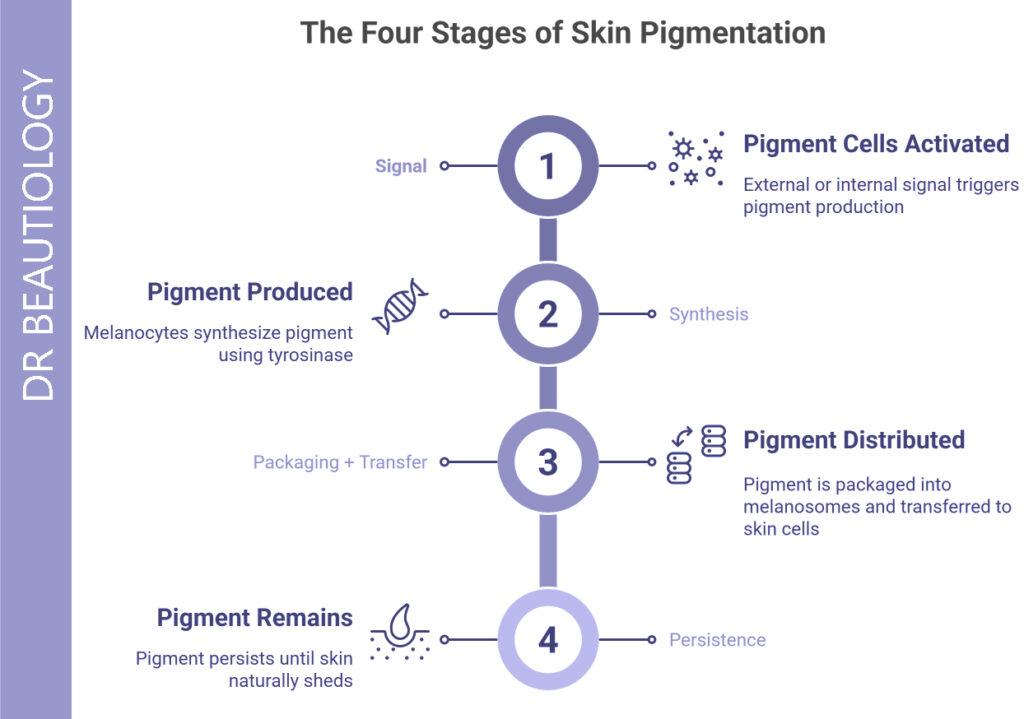
Here’s the simplest useful model:
- Signal: something tells pigment cells to switch on (often light exposure, inflammation, hormones).
- Synthesis: pigment is produced inside melanocytes. (This is where the enzyme tyrosinase matters.)
- Packaging + transfer: pigment is packaged into melanosomes and transferred to surrounding skin cells.
- Persistence: pigment sticks around until the skin naturally sheds it.
Most “brightening” routines fail because they only target step 2 or step 4—while step 1 keeps firing.
Matching actives to skin behaviour, not skin labels
People try to choose actives based on skin type labels alone. Oily, dry, sensitive. Those labels are useful, but they do not explain pigmentation behaviour.
A more reliable approach is to observe how your skin responds over time.
Three common behavioural patterns
Tone changes after inflammation
If marks follow acne, friction, or procedures, inflammation is playing a strong role. Ingredients that support barrier recovery and regulate pigment distribution, such as niacinamide, are often better tolerated long term. Strong turnover without support can prolong discolouration.
Tone deepens with sun exposure
If spots darken quickly after sun exposure, pigment production signals are dominant. Ingredients that influence pigment synthesis, such as resorcinol derivatives, become more relevant. Without light control, progress will be limited.
Tone irregularity with texture change
If uneven colour appears alongside roughness or fine lines, turnover is contributing. Retinoids can help in this context, provided they are introduced slowly and supported by barrier friendly formulation.
This approach removes the pressure to find a perfect ingredient. Instead, it focuses on selecting a mechanism that matches what your skin is doing.

One strategy always helps with uneven tone – sun protection.
Best Active Ingredients for Uneven Skin Tone
Niacinamide: the steady all-rounder for “tone + tolerance”
If uneven tone makes you feel like you need the strongest thing available, niacinamide is the reminder that consistency beats intensity.
What the evidence suggests
Across clinical research, topical niacinamide has been associated with:
- improved appearance of hyperpigmented spots and overall skin colour over time
- improvements in fine lines and skin texture in controlled facial studies
- better barrier resilience, meaning skin becomes less reactive to everyday stressors
Mechanism, simplified
Niacinamide is repeatedly described as helping with uneven tone by influencing how pigment is distributed (not only how it’s produced) and by supporting a calmer, more resilient barrier environment.
In formulations
Niacinamide is commonly used at higher cosmetic-range concentrations for even tone, because skin generally tolerates it well with long-term use. However, a good place to start is 2-5%. Check out more here.
Where niacinamide shines
- When your tone issue is tied to reactivity (PIH, redness-prone skin, over-exfoliated skin)
- When you want a tone active that doesn’t constantly pick fights with your skin barrier
Where expectations need adjusting
Niacinamide is useful, but it’s not usually the “overnight spot eraser.” If your spots are very stubborn, you may need a second lever—like a synthesis inhibitor or a stronger turnover agent.

Niacinamide is one of the rare skincare actives that shows benefits across multiple visible domains—tone, texture, and signs of ageing.
Resorcinol derivatives (including 4-hexylresorcinol): targeting pigment production
Resorcinol derivatives are designed to interact with the pigment-making machinery—particularly enzyme tyrosinase.
If niacinamide is about distributing pigment more evenly, resorcinols are more about turning down the pigment production.
4-hexylresorcinol (4-HR): why it’s worth attention
In the Shariff et al. study, 4-hexylresorcinol stood out in lab testing as a strong tyrosinase inhibitor compared with several classic brightening agents.
More importantly, the same paper didn’t stop at lab work. It moved into a human split-face trial comparing:
- a niacinamide-only formula, and
- the same formula with added 4-hexylresorcinol.
The combination side showed better improvement in the appearance of hyperpigmented spots than niacinamide alone, and it also showed additional improvements in visible signs commonly associated with ageing (like the look of fine lines and measures linked with firmness).
This shows that a two-pathway approach outperformed a single-pathway approach.
Mechanism, simplified
- Resorcinol derivatives: reduce pigment formation by interacting with tyrosinase-driven pathways.
- 4-HR + niacinamide: combines pigment-production control with pigment-distribution and skin-support pathways.
Please keep in mind that real-world outcomes depend on:
- how well the ingredient is delivered to the right skin layer,
- whether the formula is used consistently,
- and whether the routine also reduces the triggers (especially light exposure and irritation).
Pro tip
If you’re choosing between a “production” active and a “distribution” active, ask yourself:
- Do my spots behave like little islands that darken with the sun? (production angle)
- Or do they behave like marks that follow irritation? (distribution + inflammation support angle)
Retinoids: pigment support through turnover
Retinoids are a broad family of vitamin A-related compounds used for visible skin ageing and uneven tone.
They’re effective—but also can cause irritation and barrier disruption in some people.
Mechanism, simplified
- retinoids can support more even tone because they increase epidermal turnover—in other words, they help the skin cycle through pigmented surface cells more efficiently.
The trade-off
The problem with retinoids is that they can irritate skin and affect barrier properties.
This is where common misconception often creeps in: people think irritation is proof that it’s “working.” Irritation isn’t a requirement for benefit, and too much irritation can create the very inflammation that makes uneven tone harder to settle.
In formulation (which retinoid to pick)
- some retinoids are more active but less tolerated,
- others are milder and may be easier for long-term use.

Retinoid choice is important because uneven tone is usually a long game; the most tolerable retinoid is often the best choice, not the most powerful one.
Photoprotection as a pigment strategy
What the study suggests
Participants with moderate-to-severe facial hyperpigmentation followed a regimen that centred on:
- daily mineral sunscreen use
- frequent reapplication
- and tinted protection using iron oxides (positioned as protection against visible light as well as UV)
Over time, the study reported improvements in clinician-rated pigmentation scores and great user-perceived improvements in radiance, evenness, and confidence.
What it cannot prove (and why that’s okay)
Because the study was open-label (no blinded control group), it can’t separate:
- biological fading of pigment
from - optical correction from tint
from - the benefits of simply being more consistent with protection.
But we can safely conclude that:

A routine that reduces pigment triggers (especially light exposure) can make a meaningful difference, and it can do so in ways you can see and feel.
Comparison table: how to chose the best active Ingredients for uneven skin tone?
| Ingredient category | The “lever” it pulls | Best match | Main limitation to respect |
| Niacinamide | Pigment distribution + barrier resilience | PIH-prone, reactive, uneven tone with sensitivity | Not always the fastest for stubborn isolated spots |
| Resorcinol derivatives (e.g., 4-HR) | Pigment production (tyrosinase-linked pathways) | Stubborn spots, sun-driven darkening | Needs consistent use + trigger control for best results |
| Retinoids | Turnover (helps clear pigmented surface cells) | Tone + texture + visible ageing concerns | Irritation can limit long-term use |
| Photoprotection (including tinted/iron oxides in regimen studies) | Reduces triggers (UV and visible light exposure) | All pigment patterns, especially recurrent ones | Works best when it’s consistent and realistic |
Why combination strategies often work better than single actives
Across the scientific literature on uneven skin tone and hyperpigmentation, one finding appears again and again: skin pigmentation is regulated by multiple biological pathways, not a single mechanism or active ingredient.
When treatment relies on a single mechanism, progress can plateau. This is not because the ingredient has stopped working, but because another part of pigment biology is still active.
This mirrors long-standing dermatology practice. Clinicians have used combination therapy for uneven skin tone and hyperpigmentation for decades because targeting multiple pigment pathways at once improves results while allowing lower, better-tolerated doses of individual active ingredients.
From a skin health perspective, this reduces irritation risk and improves adherence. Skin that tolerates treatment is skin that continues treatment.
Formulation properties that influence results
Ingredient choice is only part of the equation. How an active is delivered and tolerated determines whether its biology translates into visible change.
Concentration and exposure
Many pigment actives work through cumulative exposure rather than immediate effect. Products designed for regular leave-on use often perform better than those used sporadically.
Stability and irritation
Retinoids are effective but sensitive to formulation and tolerance. When irritation disrupts the barrier, pigment signals can increase. This is why slower introduction and barrier-supportive formulations are a better option.
Resorcinol derivatives require an appropriate formulation to reach the target layer of skin. Without consistent delivery, enzyme inhibition observed in laboratory studies may not translate to the face.
The role of daily light exposure
The open-label regimen study highlights how consistent photoprotection changes pigment behaviour over time; reducing light signals reduces ongoing pigment stimulation.
Sun protection does not replace pigment actives. It allows them to work under more stable conditions.
Setting expectations around even skin tone
Many people treat uneven skin tone as an urgent problem, yet urgency rarely leads to better pigmentation outcomes.
Pigment changes reflect cumulative signals and gradual correction. Improvements seen in controlled studies occur over weeks to months, not days. This is slow progress, as it is normal for skin biology.
A more helpful perspective is to view even tone as a process of guidance rather than correction. When pigment signals are reduced, production is moderated, distribution is regulated, and turnover proceeds without irritation, skin gradually appears more uniform.
This reframing changes the emotional experience of treatment. Instead of constantly switching products, attention shifts to consistency, tolerance, and alignment with how the skin functions.
A calmer way to move forward
If you take one thing from all of this, let it be this: even skin tone is not something you force into submission. It is something you support by working with how skin actually responds to light, inflammation, and time.
Once you understand the biology behind the spots, decisions become simpler. Understanding why a combination works, why irritation slows progress, and why consistency matters more than intensity gives you long-term confidence, not just short-term improvement.
That is the lens I use when I create education, formulations, and conversations here. Science first. Skin health always.
Subscribe for clear, evidence-led skincare explanations that help you understand your skin and make confident decisions over time.
Talk to you soon!
Dr Bozica