

Understanding Retinol Skincare: Why It’s Worth Knowing About
If you’ve ever wondered why so many skincare experts mention retinol, it’s because this form of vitamin A genuinely changes how skin behaves. When used correctly, it helps skin renew itself and rebuild important support structures like collagen. The goal here is to show you what retinol does, how it does it, and what scientists have actually found in well‑designed studies.

Key takeaway: Retinol helps skin look and function more like it did when it was younger by encouraging healthy cell turnover and collagen renewal.
- Understanding Retinol Skincare: Why It’s Worth Knowing About
- What Retinol Is and How It Differs From Other Forms of Vitamin A
- How Retinol Works Inside the Skin
- Retinol Skincare Side Effects: Why They Happen and How to Reduce Them
- Why Formulation Matters: Stability, Vehicle and Concentration
- Combining Retinol With Other Skincare Ingredients
- Building a Practical Retinol Skincare Routine
- Retinol vs Tretinoin: Choosing What’s Right for You
- The Bigger Picture: What Retinol Skincare Means for Skin Health
What Retinol Is and How It Differs From Other Forms of Vitamin A
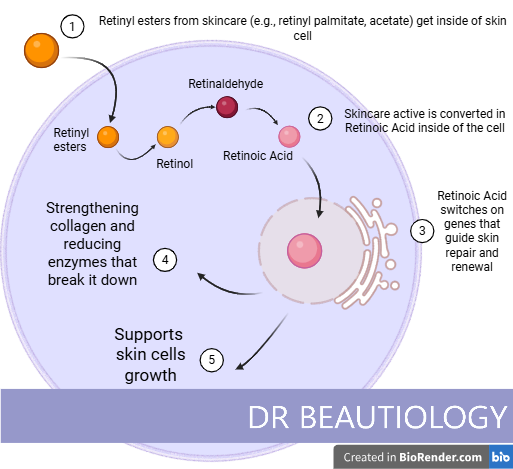
Retinol is part of a group of vitamin A compounds called retinoids. Once applied, enzymes in your skin convert retinol into retinaldehyde, and then into retinoic acid—the active form your skin cells recognise. Retinoic acid then switches on specific genes that support repair and renewal. This conversion pathway explains why retinol works, though usually a bit more gently than prescription retinoic acid.
Retinoid Comparison Table
| Compound | Where You Get It | Conversion Steps to Retinoic Acid | How Well It Works (based on the studies) | Typical Irritation | Practical Notes |
| Tretinoin (retinoic acid) | Prescription only | None (already active) | Strongest results in clinical trials; improves wrinkles and texture | High | The clinical gold standard, but can be too strong for many beginners |
| Retinol | Over the counter | Two | Produces similar biological changes as tretinoin but milder and slower | Moderate | The best‑studied non‑prescription form; strong results in both aged and photoaged skin with gradual results |
| Retinaldehyde | Over the counter | One | Effective at 0.05–0.1%; good elasticity and wrinkle results | Moderate | A higher-efficacy option than retinol with a narrower tolerance window |
| Retinyl esters | Over the counter | Multiple | Gentle; limited evidence of major change when used alone | Low | Often used in combination formulas for mild improvement |

Critical tip: Some research used occlusive bandages or non‑facial skin sites to enhance penetration, so results may look slightly stronger than what we’d expect in daily skincare use.
How Retinol Works Inside the Skin
Your skin treats retinol as a raw ingredient. It processes it into retinoic acid, which then enters cell nuclei—the control centres—where it switches on genes that guide repair and renewal. Two main pathways exist. One focuses on strengthening collagen and reducing enzymes that break it down. The other supports keratinocyte (skin cells) growth in the outer layers. The balance between these depends on natural carrier proteins inside cells.
In simple terms, retinol helps skin replace old, weak cells with newer, more organised ones while strengthening the structure beneath.
Epidermis: In a human biopsy study, 0.1% retinol increased the thickness of the surface skin by about 46% in four weeks, compared to about 79% with the same amount of tretinoin. This thickening represents healthier, more active skin, not irritation.
Dermis: The same study found increases in collagen‑related genes (COL1A1 and COL3A1) and collagen proteins. Another trial in elderly participants using 0.4% retinol for 24 weeks showed a 40% rise in glycosaminoglycans, molecules that hold water and keep skin plump (one of them is hyaluronic acid), plus a boost in type I procollagen, which is essential for firmness.
Key takeaway: Retinol improves both the top layer and deeper support structure of the skin by increasing turnover, hydration, and collagen production.
Limitation to note: Many early studies used small groups for skin biopsies. Results consistently showed improvement, but the exact percentages may vary in larger studies.

Smoothness often appears before visible wrinkle reduction because retinol first increases moisture‑holding molecules before building deeper collagen.
What It Means in Practice
Across these studies, retinol improved wrinkles, texture, and measurable skin biology in both naturally aged and sun‑damaged skin. Tretinoin remains stronger at equal concentration but can be harder to tolerate. Retinol usually delivers steadier progress because most people can use it consistently.
Retinol Skincare Side Effects: Why They Happen and How to Reduce Them
Every active ingredient has a learning curve, and retinol is no exception. The same cellular changes that make skin smoother can also cause temporary irritation while your skin adjusts. Scientists call this “retinoid dermatitis.” It usually shows up as mild redness, dryness or flaking.
What’s happening in the skin: When retinol speeds up cell turnover, older cells shed faster than usual. The skin barrier needs time to strengthen again. Studies show this irritation is temporary and tends to ease within a few weeks once the skin adapts.
In numbers: In the 2007 Kafi trial, most of the 36 participants experienced mild redness or dryness, and only three withdrew due to irritation. Similar mild reactions are noted in dermatology texts.
Practical steps to reduce irritation:
- Start slow – one or two nights per week and increase gradually.
- Always follow with moisturiser. A ceramide‑rich or peptide moisturiser supports barrier repair.
- Avoid layering retinol with strong exfoliating acids or benzoyl peroxide on the same night.
- Use sunscreen every morning. Skin may be more reactive to sunlight during adjustment.
Pro tip: If your skin becomes tight or stingy, take a two‑day break, then reintroduce retinol less often. The benefits come from consistency, not intensity.
Why Formulation Matters: Stability, Vehicle and Concentration
The form retinol takes inside a product determines how well it works. Retinol is sensitive to air and light, so it breaks down easily if not properly protected.
Packaging: Opaque, air‑tight containers preserve retinol best. Jars that are opened repeatedly can reduce potency.
Vehicle: Cream or lotion bases are usually more stable and better tolerated than alcohol‑heavy gels. In the Kafi study, a lotion base allowed elderly participants to use 0.4% retinol with minimal irritation.
Concentration: Higher is not always better. Studies show clear benefits from 0.1–0.3% retinol, with no need to rush to stronger versions. In the 2015 data, increasing concentration improved results only slightly but raised irritation.
| Feature | What the Evidence Shows | What To Look For in a Product |
| Packaging | Light and oxygen degrade retinol. | Choose air‑tight, opaque packaging such as pumps or tubes. |
| Vehicle | Cream or lotion reduces irritation compared with gel bases. | Look for moisturising ingredients like glycerin, ceramides or niacinamide. |
| Concentration | 0.1–0.3% effective and well tolerated. | Begin here before moving higher. |
| Stabilisation | Encapsulation and antioxidant blends slow oxidation. | Check for mentions of stabilised or encapsulated retinol. |
Combining Retinol With Other Skincare Ingredients
Retinol works best when paired wisely. Some ingredients soothe and support, while others compete or destabilise it.
Compatible partners:
- Niacinamide: Strengthens the skin barrier and reduces redness, making retinol easier to tolerate.
- Peptides: Support collagen synthesis, complementing retinol’s effects (yes, you can use retinol and copper peptides, but should you? Check out my post about Copper Peptides vs. Retinol & Vitamin C).
- Moisturisers with ceramides: Reduce dryness and improve comfort.
What to avoid together:
- Strong acids (like glycolic or lactic acid) on the same night can increase irritation.
- Benzoyl peroxide can inactivate retinol if applied simultaneously.
Pro tip: Use retinol at night and save exfoliating acids or brightening serums for alternate evenings.
Building a Practical Retinol Skincare Routine
Putting science into action is simple when you understand what your skin needs at each stage.
Step 1: Start with 0.1–0.3% retinol in a stable cream or lotion.
Step 2: Apply a pea‑sized amount to the face two nights per week for the first fortnight. Gradually build up to every second night.
Step 3: Follow with moisturiser. This helps reduce dryness and keeps the barrier calm.
Step 4: Use broad‑spectrum SPF 30 or higher every morning.
Timeline of changes:
- Weeks 1–4: Skin may feel smoother; some dryness is normal.
- Weeks 4–12: Texture, firmness and fine lines begin to improve.
- Beyond 12 weeks: Collagen support builds, and results continue with regular use.
Limitation to remember: Benefits fade if treatment stops. In the Kafi study, wrinkle improvement lessened after retinol was discontinued for several months.
Pro tip: Consistency beats intensity. Missing a few nights won’t undo progress, but stopping completely will gradually reverse gains.
Retinol vs Tretinoin: Choosing What’s Right for You
| Feature | Retinol | Tretinoin (Retinoic Acid) |
| Availability | Over the counter | Prescription only |
| Conversion in Skin | Requires two steps to become active | Already active |
| Strength | Moderate | Strong |
| Tolerance | Better suited to sensitive or dry skin | May cause significant peeling or redness |
| Best For | Long‑term skin rejuvenation and maintenance | Advanced photoaging or acne under medical supervision |
Retinol activates the same biological pathways as tretinoin but more gently. For most people seeking smoother, stronger skin, a well‑formulated retinol is both effective and practical.
The Bigger Picture: What Retinol Skincare Means for Skin Health
Retinol is more than a cosmetic ingredient. It’s one of the few actives shown in peer‑reviewed research to reverse signs of both natural and sun‑induced ageing. It improves texture, supports collagen, and strengthens the skin barrier. These changes make skin not only look better but function better.
Think of retinol as long‑term training for your skin. The results build slowly and last only with consistent care.
If you’re new to retinol, start small, go slow, and protect your progress with daily SPF (I cannot emphasise SPF enough; you must wear it if you use retinol). When in doubt, talk with a qualified skin professional who can tailor the routine to your skin type.
Your skin is adaptable and capable. Retinol simply reminds it how to behave like its younger self.
Talk to you soon!
Dr Bozica