Can you use glycolic acid and retinol together?
Yes, but only if the skin can handle the combined stress.
Retinoids increase cell turnover and change how skin cells mature (more on how retinol works here). Glycolic acid loosens the bonds between surface cells so they shed more easily. Those actions can complement each other, but they also increase the chance of barrier disruption when used too often, too soon, or at strengths the skin cannot manage.
If your skin is already tight, flaky, stinging, or reactive, adding both usually increases water loss and irritation. If your skin is stable and you introduce them carefully, the combination can be workable. The answer depends less on theory and more on the condition of the skin in front of you.
- Can you use glycolic acid and retinol together?
- Why people want to use them together
- Why the combination can go wrong
- Where people get it wrong
- How to use glycolic acid with tretinoin without damaging your barrier
- If you are getting professional glycolic peels
- Where this combination helps most
- Who should be more careful
- What I would actually tell a friend
- Conclusion
Why people want to use them together
These ingredients do different jobs, which is why people try to combine them.
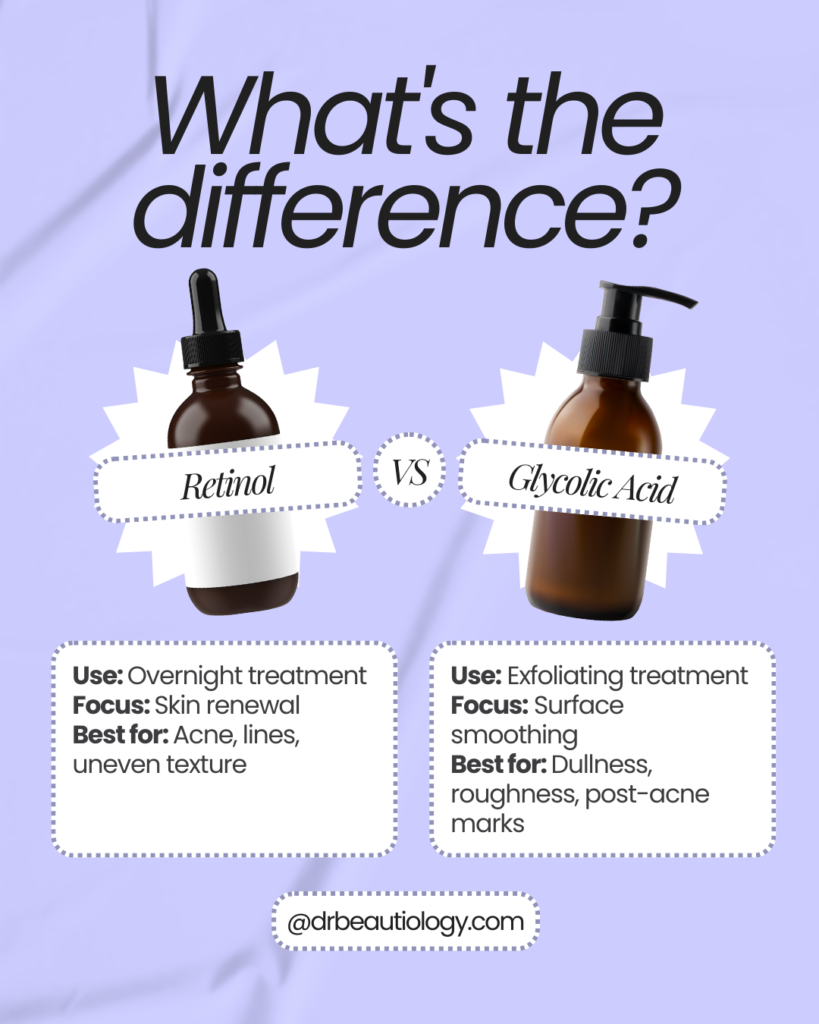
Retinoids act deeper in the process of skin renewal. They help normalise the way cells develop and shed, which is why they are used for acne, uneven texture, and signs of photoageing. Their effect is gradual because they change cellular behaviour rather than simply removing what is already sitting on the surface.
Glycolic acid works closer to the top of the skin. It breaks up the glue-like connections that keep dead surface cells attached, so the outer layer sheds more evenly. That can make skin feel smoother, look brighter, and appear less congested.
When people combine the two, they are usually trying to get both kinds of change at once: better surface texture from glycolic acid and longer-term structural improvement from a retinoid. The idea is reasonable. The difficulty comes from dose, frequency, and timing.
Why the combination can go wrong
The main problem is not that the ingredients cancel each other out. The main problem is cumulative irritation.
The outermost layer of skin acts as a barrier that limits water loss and keeps irritants out. Retinoids can weaken that barrier during the adjustment period because they speed up renewal before the skin has adapted. Glycolic acid can add further stress by accelerating exfoliation. When both are used aggressively, the barrier may lose water faster than it can recover.
That is why the signs of trouble are so predictable. Skin becomes dry because it is losing more water. It stings because the barrier is letting more irritants in. It looks red because inflammation increases blood flow. In some people, especially those prone to post-inflammatory pigmentation, that inflammation can also leave dark marks behind.
This is why the pairing is not simply a yes-or-no question. It is a question of how much stimulation the skin can recover from between applications.
Where people get it wrong
A common mistake is assuming that stronger routines produce faster progress.
If renewal is pushed beyond what the barrier can tolerate, inflammation rises and recovery takes priority. That slows useful progress because the skin is spending its resources managing irritation rather than adapting well to treatment.
Another mistake is using irritation as proof that the routine is effective. Some actives can cause a settling-in phase, but persistent burning, stinging, flaking, and redness are signs that the barrier is under strain. Inflammation is not a shortcut to better skin. It is often the reason people stop using ingredients that might otherwise have helped them.
How to use glycolic acid with tretinoin without damaging your barrier
The simplest way to reduce irritation is to avoid introducing both at the same time.
If you start both together and your skin reacts, you learn almost nothing. You do not know which product is responsible, whether the issue is the formula or the frequency, or whether the combination itself is too much. Starting with one active lets you measure the skin’s response to a single variable.
Many people begin with a retinoid because it can become the backbone of a long-term routine once tolerated. Others begin with glycolic acid because they want faster change in surface texture or because their skin does not tolerate retinoids well. Either starting point can work if the skin is given time to adjust.
Once both are tolerated individually, separate nights are usually the most sensible structure. That spacing gives the barrier time to recover between applications. A rest night can also be useful if the skin is easily irritated, because recovery time is often what prevents small signs of irritation from turning into a larger problem.
If you are getting professional glycolic peels
A professional glycolic peel is not just a stronger version of an at-home acid product. It is a procedure in which outcome depends on concentration, how the product is applied, how long it remains on the skin, and how it is neutralised or removed.
That changes the risk profile. A peel can push exfoliation much further than a leave-on product, which is why timing around other actives becomes important. If someone is using tretinoin before a peel, the skin may be more reactive because turnover has already been accelerated and the barrier may be less robust.
For that reason, timing should be planned with the clinician performing the peel. This is not the place for guesswork. The same logic applies after the peel, because sun exposure and harsh skincare can intensify inflammation while the skin is recovering.
Where this combination helps most
Using both can make sense when the skin has more than one issue at the same time.
A retinoid is often chosen when the goal is long-term improvement in acne behaviour, uneven texture, or photoageing. Glycolic acid is often chosen when the issue is rough surface texture, dullness, or visible congestion. When those concerns overlap, some people benefit from using both at different times in the week.
That does not mean both are necessary for everyone. It means their strengths are different. One changes skin behaviour over time. The other changes the condition of the outer surface more directly.
Who should be more careful
People with easily irritated skin usually need a slower approach because their barrier reaches its limit sooner.
This includes people who sting easily, develop flaking quickly, get dark marks after inflammation, or struggle to use sunscreen consistently. In these cases, even a reasonable combination can become problematic because the skin has less capacity to recover between applications, and unprotected UV exposure can intensify pigment change after irritation.
A slower schedule is not a sign that the skin is failing. It is simply a better match for skin that has a lower tolerance for repeated stress.
What I would actually tell a friend
Choose the ingredient that best matches your main concern and start there.
If the priority is acne control or longer-term texture change, a retinoid often makes more sense as the first step. If the priority is roughness, dullness, or surface congestion, glycolic acid may be the simpler place to begin. Starting with the ingredient most closely linked to your main goal makes it easier to judge whether the routine is doing anything useful.
Once the first product is tolerated and the skin is stable, you can consider adding the second. Change one variable at a time and watch the skin’s response. That approach gives you usable information, which is what prevents routines from becoming confusing and unnecessarily irritating.
Conclusion
Better skin usually comes from matching the tool to the problem, then using it at a frequency the skin can recover from.
Retinoids and glycolic acid can work in the same routine, but the result depends on skin tolerance, formula strength, timing, and consistency. When people run into trouble, it is usually because the skin is being pushed faster than it can adapt.
Thanks for reading.
Tell me: are you using a retinoid, glycolic acid, or both?
And what should I break down next: retinoid irritation versus purging, or glycolic acid versus salicylic acid for acne?
If you want skincare explained by a scientist who actually formulates, follow my page. I publish new evidence-based breakdowns every week.