The air beside your skin can change how your skin feels. Low relative humidity can reduce the water held in the stratum corneum, the thin outer layer that gives the skin surface much of its flexibility. A light formula may leave too little residual film to slow evaporation for as long as your skin needs.
- How Low Humidity Changes the Stratum Corneum
- Why Winter Air Can Dry Skin on a Rainy Day
- Why Your Moisturiser Feels Weaker in Dry Air
- How to Adjust Your Skincare Routine for Low Humidity
- Dry Air and Atopic Dermatitis
- Should You Use a Humidifier for Dry Skin?
- Why Skin Feels Dry on a Long Flight
- How to Judge Whether the Routine Is Working
- References
How Low Humidity Changes the Stratum Corneum
The stratum corneum (surface layer of skin) consists of flattened corneocytes (skin cells) surrounded by organised lipid layers. Inside the corneocytes, natural moisturising factor binds water. The lipids between the cells slow the passage of water towards the air.[2]
Water allows this layer to bend as your face moves. As its water content falls, the surface becomes less flexible and its microscopic contours change. You may feel tightness before you see flakes. Makeup often reveals the change first because pigment collects where the surface has become less even.
Egawa and colleagues placed the cheeks and inner forearms of healthy volunteers in a low-humidity environment for three or six hours. They measured the electrical properties related to stratum-corneum water content, recorded TEWL and analysed replicas of the skin surface.[1]
Water content fell at both sites after three hours and remained lower at six hours. Several surface-roughness measurements changed. TEWL decreased between the start of exposure and the six-hour measurement.[1]
| Measurement | What it records | How it relates to what you feel |
|---|---|---|
| Stratum-corneum hydration | Water held within the outer skin | Lower readings commonly accompany tightness and reduced surface flexibility |
| TEWL | Water-vapour flux across the epidermis | The result depends on skin temperature, airflow, ambient humidity and acclimatisation |
| Surface replica | Microscopic contours and furrows | Changes can correspond with a rougher-looking surface |
If your cheeks tighten in a heated room, the outer skin may be holding less water or your moisturiser film may be fading too quickly. Test a more persistent cream or a second application on the affected area.
Why Winter Air Can Dry Skin on a Rainy Day
Relative humidity describes how close the air is to saturation at its current temperature. Cold air reaches saturation with less water vapour than warm air. When cold outdoor air enters a building, heating raises its water-vapour capacity while the amount of vapour stays approximately the same. Its relative humidity falls.
This is why a rainy winter day can still produce a dry office or bedroom. The outdoor humidity shown on your phone describes the air at the weather station. Your face spends hours in the warmer air beside a heater.
A small hygrometer gives you a direct reading of the room. If the number stays low and your skin becomes tight at the same time each day, the environment is a plausible contributor. You can then test one change, such as a creamier moisturiser or an extra application to the cheeks, while keeping the rest of the routine stable.
Why Your Moisturiser Feels Weaker in Dry Air
A moisturiser is a structured formulation. Its water phase, oil phase, emulsifiers and texture determine how it spreads and what remains after the water in the product begins to evaporate.[4]
Most moisturisers combine humectants with an oil phase. The humectants associate with water in the formula and outer skin. Emollient and occlusive materials coat the surface, improve smoothness and slow evaporation.[4]
| Formulation function | What happens on the skin | When you may need more of it |
| Humectant | Water associates with ingredients such as glycerol or urea within the formula and outer skin | The surface feels rough or lacks flexibility |
| Emollient | Oils and related materials coat uneven corneocyte edges and improve slip | Makeup catches and the skin feels rough to the touch |
| Occlusive | A persistent film reduces the rate of evaporation | Comfort fades quickly beside a heater or in cold wind |
An INCI list confirms which ingredients are present. Product texture, lipid organisation, film thickness and evaporation behaviour come from the finished formulation. Two creams with similar lists can therefore feel very different after several hours.
How glycerol behaves when the air is dry
Glycerol binds water and influences several processes within the stratum corneum, including lipid organisation and normal shedding of surface cells. Reviews of laboratory and clinical evidence report improved hydration after topical use of glycerol-containing formulations.[5]
If a glycerol serum feels too light in a heated room, look at what remains after its water phase evaporates. A slight residual film will give brief comfort. Apply a cream over it or replace the two-step routine with one cream that already combines glycerol with emollient and occlusive ingredients.
“Humectants bind water while occlusive ingredients slow its evaporation.”
Urea can help when dry skin also feels rough. Concentration changes its behaviour. Products around 2% to 10% are commonly used for moisturising, while higher concentrations have a stronger keratolytic effect and sting more readily on irritated skin.[6] My guide to urea in skincare explains how to choose a concentration.
What petrolatum adds
Petrolatum forms a persistent water-resistant film and also enters the spaces between corneocytes in the stratum corneum. In experiments using acutely disrupted human and mouse skin, petrolatum reduced TEWL and accelerated early barrier recovery.[7]
Use a small amount on lips, around the nostrils or over a patch that repeatedly becomes rough in cold wind. For the whole face, a cream containing water and humectants often feels more comfortable during the day. Petrolatum can sit over that cream at night where extra occlusion helps.
Where the 3:1:1 lipid rule came from
Ceramides, cholesterol and free fatty acids contribute to the lipid layers between corneocytes. Their arrangement within a finished product affects how they interact with the stratum corneum.
The experiment commonly cited for a 3:1:1 rule used acutely disrupted hairless mouse skin and included preliminary testing in disrupted human skin. The researchers tested four-component mixtures containing ceramides, cholesterol, an essential fatty acid and a non-essential fatty acid. Early barrier recovery accelerated when one component was present at three times the amount of the others. The dominant component varied across the successful mixtures.[8]
The experiment used four lipid components in a specific vehicle and tested defined total lipid concentrations. Physical organisation within the emulsion also influenced delivery. The familiar three-number rule compresses these formulation variables into a ratio, while INCI order shows ingredient sequence.
Choose a ceramide product by how the finished cream performs on your skin and by clinical evidence for that formulation. Use the INCI list to identify ingredients, then use product testing to judge performance.
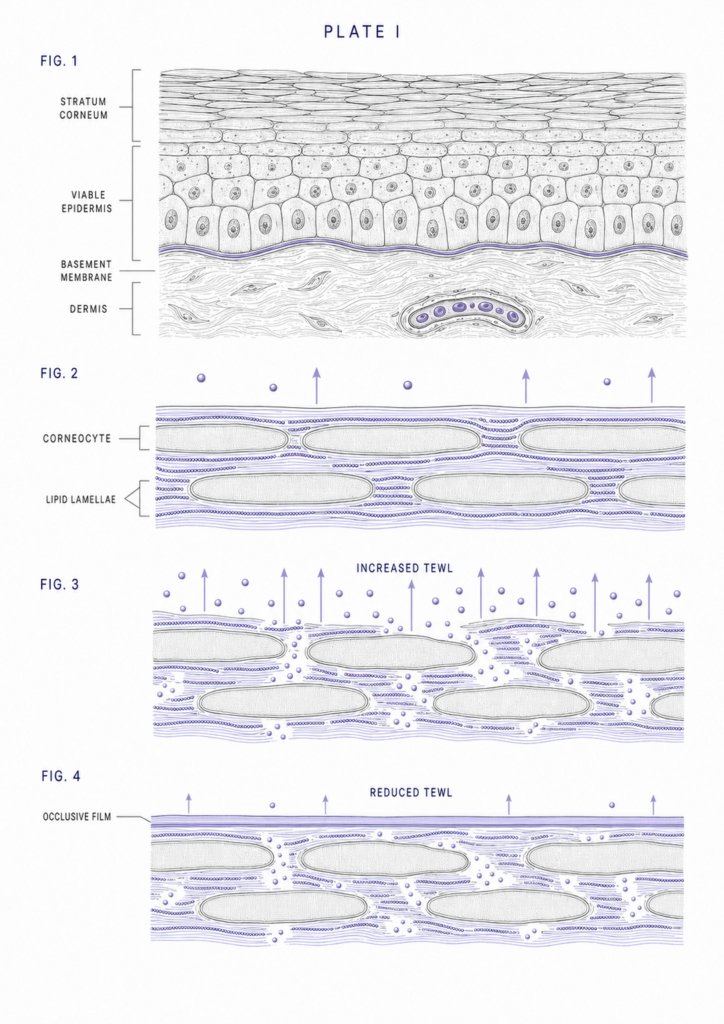
Fig. 1 shows the epidermis and upper dermis, with the stratum corneum forming the outer barrier. Fig. 2 enlarges the stratum corneum, where flattened corneocytes hold water and extracellular lipids limit its movement towards the surface. Fig. 3. during low-humidity exposure, corneocyte water content can fall, leaving the skin feeling tighter, rougher and less flexible. Fig. 4 shows how a complete moisturiser supports water retention: humectants increase water held within the stratum corneum, emollients improve surface flexibility, and the residual film slows evaporation while water-vapour movement continues. For illustration only.
How to Adjust Your Skincare Routine for Low Humidity
Notice when discomfort first appears. Tightness immediately after washing points towards the cleansing step, while comfort after application followed by tightness at midday points towards film persistence.
| What you experience | Likely contributor | First change to test |
| Skin feels tight as soon as it is dry after cleansing | Cleanser strength, water temperature or long contact with water | Use lukewarm water, shorten cleansing and try a milder cleanser |
| Cheeks feel comfortable in the morning and tight by lunch | The moisturiser leaves too little residual film for the room | Reapply to the cheeks or use a cream with more emollient and occlusive material |
| Retinoid or acid begins to sting during a dry period | Environmental dryness has reduced your tolerance for an irritating step | Reduce the frequency until cleansing and moisturising feel comfortable again |
| A balm feels greasy while itchy patches continue | Inflammation may be contributing alongside dryness | Continue regular moisturiser use and arrange clinical assessment for persistent itch or inflamed patches |
| Lips and cheeks become uncomfortable during a flight | Cabin air has reduced stratum-corneum hydration | Apply moisturiser before boarding and add petrolatum to areas that tend to crack |
Repeated washing can increase TEWL and skin-surface pH. In Voegeli’s forearm study, soap and water produced more disruption than water alone, and the effect increased with repeated washing.[9] Gentle towel rubbing and patting produced different amounts of residual water, with patting leaving the test area wet for longer. For facial care, cleanse briefly with lukewarm water and dry with light contact from the towel.
Apply a complete moisturiser after cleansing. Damp skin can make the cream easier to spread, while the formulation itself supplies the ingredients that bind water and slow evaporation. Reapply to the areas where tightness returns.
Change one step and watch the result for several days. This keeps the cause of improvement or irritation traceable.
Dry Air and Atopic Dermatitis
Atopic dermatitis combines inflammation with changes in barrier function. Cold and dry conditions are associated with greater symptoms or healthcare use in some populations, although climate acts alongside allergens, irritants, infection and treatment adherence.[2]
The 2023 American Academy of Dermatology guideline gives a strong recommendation for moisturisers in adults with atopic dermatitis. It also strongly recommends several anti-inflammatory topical treatments, including topical corticosteroids and calcineurin inhibitors.[10]
Regular emollient care supports dry, crack-prone skin. Prescribed treatment controls the inflammatory component. Seek clinical advice when winter brings persistent itch, recurrent inflamed patches, cracking or oozing. Additional cosmetic layers address dryness, while a clinician can assess and treat the inflammation.
Should You Use a Humidifier for Dry Skin?
A humidifier raises the relative humidity around your skin. Across the workplace trials collected in a Cochrane review, average self-reported skin dryness changed little, and confidence in the result was very low.[11]
Treat a humidifier as an environmental trial. Measure the room with a hygrometer and record whether your skin remains comfortable for longer. The US Environmental Protection Agency recommends indoor relative humidity between 30% and 50% and advises keeping humidification at or below 50% to reduce condensation and biological growth.[12]
Clean the device according to its instructions and replace the water as directed. Condensation on windows or damp surfaces indicates excessive output, so reduce the setting or stop the device until the room dries.
Why Skin Feels Dry on a Long Flight
Guéhenneux and colleagues followed eight healthy women during long-distance flights. Skin capacitance fell on the face and forearms, with the largest change on the cheeks.[13] The measured response fits the tight, papery feeling many travellers notice after several hours in cabin air.
Before boarding, apply your usual moisturiser and add petrolatum to lips or another area that tends to crack. During the flight, reapply cream when your cheeks begin to feel tight, since your own comfort provides a more relevant schedule than the clock.
A facial mist wets the surface briefly. Applying moisturiser afterwards leaves a film that slows the evaporation of that added water. If you enjoy using a mist, pair the two steps.
Drink according to thirst and your general health needs. Topical care addresses the stratum corneum directly. I review the evidence on fluid intake in Does Drinking More Water Really Hydrate Your Skin?.
How to Judge Whether the Routine Is Working
Watch what your skin does over several days. Improvement should appear as less tightness after washing, longer comfort between applications and fewer areas where makeup catches.
When a cream helps after application but the effect fades quickly, increase the amount on the affected area or choose a formulation that leaves a more persistent film. Burning, increasing redness or an itchy rash points towards irritation or dermatitis, so stop the suspected product and allow the skin to settle.
Judge your moisturiser within the room and routine where you use it. The lotion that suits humid weather may leave too little film in a heated office. Seasonal dryness often improves after a richer texture, a second application or less irritating cleansing. Persistent inflamed itch needs treatment for the skin condition itself.
References
- Egawa M, Oguri M, Kuwahara T, Takahashi M. Effect of exposure of human skin to a dry environment. Skin Research and Technology. 2002;8(4):212–218.
- Engebretsen KA, Johansen JD, Kezic S, Linneberg A, Thyssen JP. The effect of environmental humidity and temperature on skin barrier function and dermatitis. Journal of the European Academy of Dermatology and Venereology. 2016;30(2):223–249.
- Green M, Kashetsky N, Feschuk A, Maibach HI. Transepidermal water loss: environment and pollution. Skin Health and Disease. 2022;2(2).
- Purnamawati S, Indrastuti N, Danarti R, Saefudin T. The role of moisturizers in addressing various kinds of dermatitis: a review. Clinical Medicine & Research. 2017;15(3–4):75–87.
- Fluhr JW, Darlenski R, Surber C. Glycerol and the skin: holistic approach to its origin and functions. British Journal of Dermatology. 2008;159(1):23–34.
- Piquero-Casals J, et al. Urea in dermatology: a review of its emollient, moisturizing, keratolytic, skin-barrier enhancing and antimicrobial properties. Dermatology and Therapy. 2021;11(6):1905–1915.
- Ghadially R, Halkier-Sørensen L, Elias PM. Effects of petrolatum on stratum corneum structure and function. Journal of the American Academy of Dermatology. 1992;26(3 Pt 2):387–396.
- Man MQ, Feingold KR, Thornfeldt CR, Elias PM. Optimization of physiological lipid mixtures for barrier repair. Journal of Investigative Dermatology. 1996;106(5):1096–1101.
- Voegeli D. The effect of washing and drying practices on skin barrier function. Journal of Wound, Ostomy and Continence Nursing. 2008;35(1):84–90.
- Sidbury R, et al. Guidelines of care for the management of atopic dermatitis in adults with topical therapies. Journal of the American Academy of Dermatology. 2023;89(1)–e20.
- Byber K, et al. Humidification of indoor air for preventing or reducing dryness symptoms or upper respiratory infections in educational settings and at the workplace. Cochrane Database of Systematic Reviews. 2021;12.
- US Environmental Protection Agency. Use and Care of Home Humidifiers. Updated 2026.
- Guéhenneux S, Gardinier S, Morizot F, Le Fur I, Tschachler E. Skin surface hydration decreases rapidly during long distance flights. Skin Research and Technology. 2012;18(2):238–240.